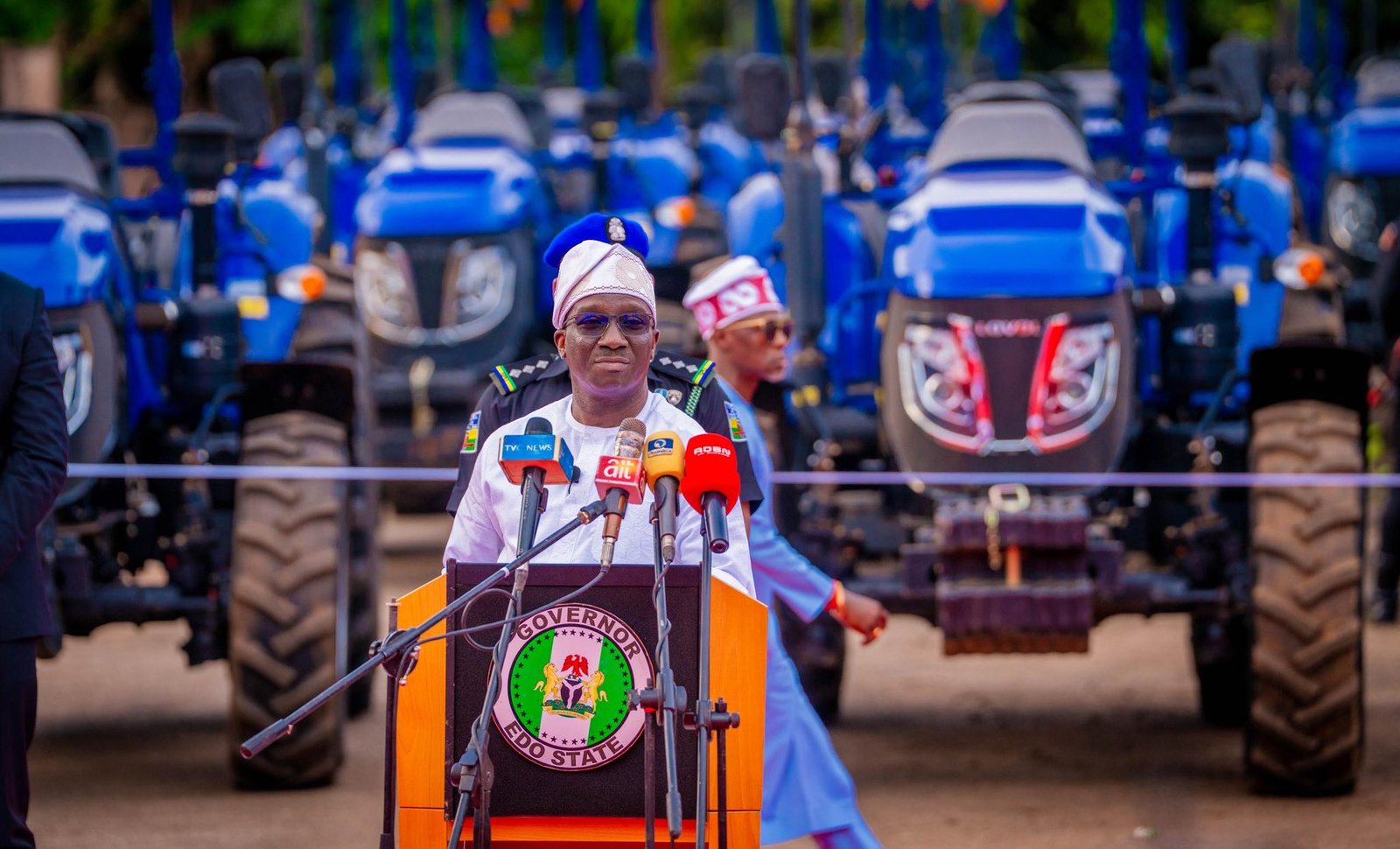
Edo State government on Monday marked a major policy milestone with the unveiling of the largest single agricultural mechanisation investment in the state’s history, signaling Governor Monday Okpebholo’s commitment to repositioning the state as a national hub for commercial agriculture and food security.
The commissioning ceremony, held at the Government House, Benin City, was presided over by Senate President Godswill Akpabio, who was on a working visit to the state alongside several federal lawmakers.

The state unveiled 30 new tractors, five bulldozers, 150 implements, and a low-bed truck, machinery expected to drastically expand Edo’s agricultural capacity, enhance productivity, and accelerate rural development.
Gov. Okpebholo said the acquisition forms a central pillar of his administration’s agricultural transformation agenda, designed to open thousands of hectares of new farmlands, attract agribusiness investments, reduce post-harvest losses, and create sustainable employment opportunities for youths and women.
Read also:
- Gov. Zulum approves ₦1bn for take-off of federal university in Borno
- Foundation leads drive for value reorientation for children
- Fintiri sends off Turkey-bound scholars with charge to uphold discipline
“This is a strategic investment that will change the trajectory of Edo’s economy,” he said.
“We are laying the foundation for food sufficiency, commercial-scale farming, and long-term prosperity for our people.”
The governor added that the machinery symbolizes a shift from subsistence agriculture to full mechanisation, ensuring Edo State becomes a reliable contributor to national food reserves while reducing the state’s vulnerability to economic shocks.
Gov. Okpebholo reiterated his administration’s resolve to ensure clarity and responsibility in the management of public funds, referencing concerns surrounding the Museum of West African Art (MOWAA) project and calling for the repatriation of former governor Godwin Obaseki to “answer critical questions.”
Senate President Akpabio responded that the federal government would review the state’s submissions and that due process would guide all further actions.