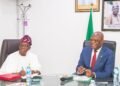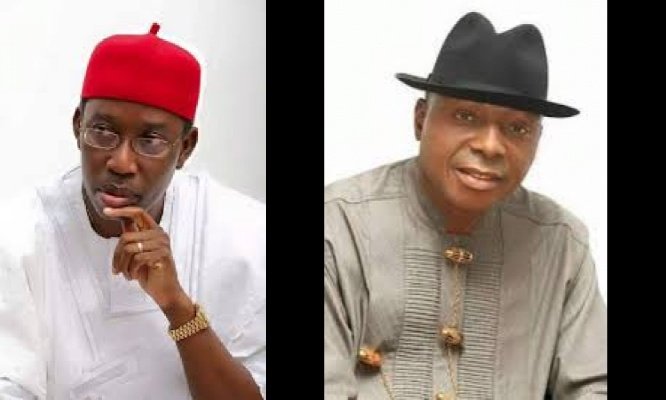
What was billed as a unity-driven All Progressives Congress (APC) stakeholders’ meeting in Asaba on Friday gradually unfolded into a revealing contest of interests, history and power, as long-suppressed tensions over the Delta State APC chairmanship came openly to the fore.
The meeting, which followed the April 28, 2025 political realignment that collapsed the entire PDP structure in Delta State into the APC, became the first major platform where the internal contradictions of the new political order were publicly tested.

Setting the tone of the engagement, Senator James Manager, speaking on behalf of Delta South, anchored his intervention on institutional memory, zoning balance and political equity.
Manager, who spoke “as a Deltan,” made it clear that the issue of the APC chairmanship was not speculative but central to the party’s stability:
“For our purpose, Delta South, Delta South occupies a very unique position as far as the congresses are concerned, in particular the state congress.”
He then took stakeholders down memory lane, tracing Delta State’s political evolution from the SDP era through the return to democracy under Chief James Ibori. According to him, the state’s political leaders deliberately adopted a balancing formula to accommodate its ethnic and senatorial diversity.
“It was agreed that the deputy governor, having emerged from Delta North, and then the rather important elective position, which is the chairman of the party, must come from Delta South.”
He cited the emergence of Chief Bamusa and later Chief Opu Edodo as party chairmen under that arrangement, stressing:
“That was SDP. That was SDP. This is the truth. This is the fact that I am trying to bring out.”
Moving to the Ibori era, Manager reminded the gathering that the same principle was sustained:
“The heavyweights met and agreed that the state chairman would come from Delta South, and that the Speaker must come from the same Delta South.”
Against this backdrop, he framed the present situation as structurally imbalanced:
“We have a governor who is doing very well, with his deputy from Delta Central and Delta North respectively. The chairman of the party—where do you think the chairman of the party will come from. For us, as Delta South APC is now, there is no conflict. There is no conflict.”
He concluded by asserting that Delta South’s demand was not a plea but a rightful claim: “I have been given this mandate to demand this as our right. Delta South, we are pleading, Your Excellency.”
However, former Governor Ifeanyi Okowa, who spoke for Delta North, made a frantic effort to play down the demand by Senator James Manager by adopting a conciliatory tone, urging restraint, unity and a step-by-step approach to party congresses.
He cautioned against allowing the chairmanship debate to dominate prematurely: “If we start from the ward level, consensus will build by itself… Otherwise, we will find these conversations overshadowing the issues that we ought to discuss at this moment.”
He insisted that leadership would take the final decisions at the appropriate time: “At the appropriate time, the leadership, in their capacity and wisdom, will take the right decisions.”
Okowa further argued that the structure and timing of congresses provided ample opportunity for dialogue: “You will find that there is a lot of gap between the ward congress, the local government congress, and the state congress… So they have given enough room for us to meet again.”
He commended Governor Oborevwori for convening stakeholders and acknowledged the existence of multiple perspectives within the party:
“There are a lot of perspectives among us—as a people, as a political family, and as a state.”
However, his call for caution immediately attracted scrutiny within party circles, particularly when viewed against events barely months earlier.
On July 8, 2025, Delta North APC leaders met in Asaba to articulate their political demands. The meeting, which Okowa attended as a leading stakeholder from the zone, openly demanded the APC chairmanship for Delta North.
At that meeting, according to multiple attendees, Okowa did not call for restraint, caution or gradualism. Instead, he reportedly spoke forcefully in support of Delta North’s position, lending political weight to their claim.
It is this contrast that has fueled accusations of selective caution and political hypocrisy, especially after Senator Manager raised an equivalent demand for Delta South at the stakeholders’ meeting.
To many Delta South leaders, Okowa’s sudden appeal for patience appeared less like statesmanship and more like strategic delay—aimed at retaining influence over the party executive structure ahead of future primaries.
Displaying what many have come to believe is the script of his godfather, Governor Sheriff Oborevwori who spoke after Okowa, re-echoed Okowa’s position on the issue.
He held that leadership should be people-driven, not personality-driven: “When people talk about leaders, what makes you a leader is the people… I am only the front for you people.”
He dismissed claims of crisis within Delta APC; “If they say there is crisis here, they are lying… But here, we are united.”
Read also:
- APC aspirants write Buhari, score Buni’s committee high
- Gov. Yusuf set to join APC in Kano on Monday
- 2023 NASS polls: No vacancy in Edo North, says APC
Yet, he acknowledged the underlying struggle for influence: “Everybody wants power. And that is the truth—everybody wants power. It’s all about interest.”
About the congresses, Oborevwori distanced himself from direct decision-making: “If you think I will come and say ‘me, me, me’—no… On the day of the election, I will not be with you.”
However, his remark urging some zones to slow down intensified perceptions of alignment with Okowa: “You are too much in a hurry for 2031. Wait for your turn—2031, wait for your turn.”
While couched as a call for patience, critics argue that the governor’s stance failed to address the core zoning imbalance, particularly given the April 28 merger that effectively reset Delta’s political architecture.
Political analysts say Governor Oborevwori now stands at a crossroads. With both the PDP and APC fused into one party, historical zoning expectations demand correction, especially in favour of Delta South.
Yet, his political lineage ties him closely to Okowa, whose perceived objective is to retain control of the APC state executive, particularly the chairmanship, as leverage over future primaries.
By echoing Okowa’s caution rather than asserting zoning clarity, many political analysts say, Oborevwori risks being viewed as a governor managing fear rather than authority—a leader caught between pleasing his godfather and enforcing equity.
As one APC insider put it, “Neutrality is not silence when history is clear.”
The Asaba meeting ended with prayers and applause, but the fault lines remain. Delta South has drawn a clear line, Delta North has already made its move, and the governor’s balancing act may soon become unsustainable.
Whether the APC in Delta State emerges united or fractured may depend on one unresolved question: Will equity prevail over godfatherism?