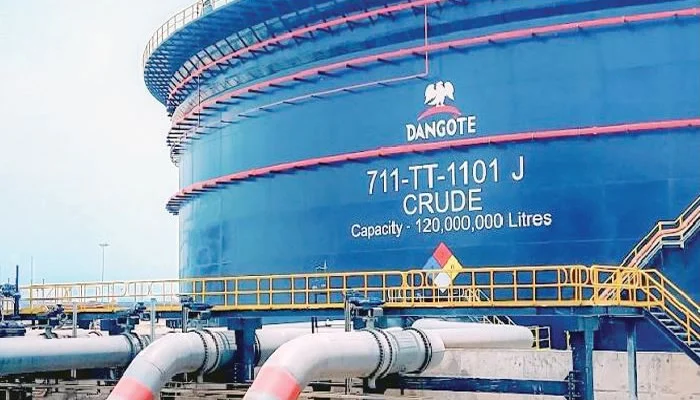
The Dangote Refinery has projected about 600 tanker calls annually as it advances toward full production capacity of 650,000 barrels per day, a development expected to reshape Nigeria’s refined products trade and maritime traffic.
Officials at the refinery’s marine terminal disclosed that roughly 800 vessels have already berthed at the facility since operations commenced, describing the figure as a strong indicator of early operational stability.

“So far we have handled 800 tankers, which in itself is a major achievement,” said Satendra Rana, Head of Marine at Dangote Refinery and Petrochemical, during a guided tour of the facility.
“As the refinery ramps up to full capacity of 650,000 barrels per day, we expect about 600 tankers per year. This includes crude imports and refined product exports, and we are equipped to manage that volume,” he added.
The $20 billion refinery officially began production on January 12, 2024, initially refining diesel and aviation fuel. Premium Motor Spirit production started in September 2024, with output gradually increasing.
Read Also:
- NMDPRA confirms Dangote Refinery provided 61% of petrol consumption n January
- Dangote Refinery hits 650,000 barrels per day as crude distillation, petrol units reach full capacity
- We do not import fuel, Nigerians get Euro-Standard products only – Dangote Refinery
At peak operations, the refinery will process 650,000 barrels of crude oil daily into petrol, diesel, jet fuel and other derivatives. The projected 600 annual tanker movements will comprise inbound crude carriers and outbound product vessels, significantly increasing activity along Nigeria’s coastline.
Terminal operators stated that the marine infrastructure is built for rapid vessel turnaround.
“Our design allows us to complete discharge or loading operations within 24 hours under normal conditions. Larger vessels may take up to 36 hours, but most ships depart within a day,” Rana explained.
The refinery operates five Single Point Mooring buoys offshore, two designated for crude imports and three for refined product exports. The offshore positioning allows access to natural deepwater channels.
According to terminal officials, the configuration reduces the need for continuous dredging and cuts maintenance costs. The deepwater access also enables the facility to receive some of the world’s largest crude carriers.
“One vessel delivered three million barrels in a single shipment, nearly twice Nigeria’s average daily crude output. We also handle two-million-barrel vessels regularly,” Rana noted.
Industry observers say the refinery’s increasing throughput and projected tanker movements could alter Nigeria’s long-standing dependence on imported refined products and reposition the country as a net exporter of petroleum derivatives.
The anticipated rise in vessel traffic is expected to stimulate port services, shipping logistics, and ancillary maritime operations while strengthening domestic fuel supply chains.
With full production capacity approaching, the refinery’s operational scale is set to influence regional energy markets and Nigeria’s balance of trade in petroleum products.