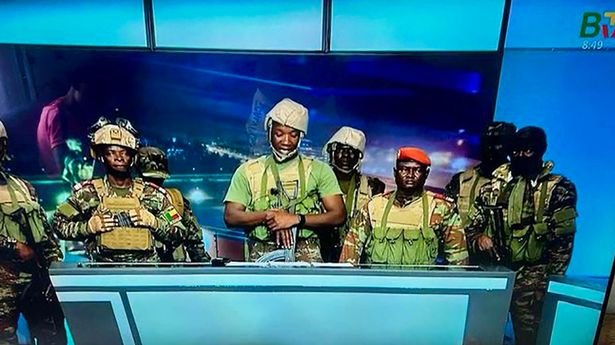
Benin, a country once praised for steady leadership, woke today to gunfire, rotor noise from military helicopters and an atmosphere heavy with fear. Reports from Cotonou and Porto Novo point to an organised move by a faction of the armed forces against President Patrice Talon. The group calls itself the Military Committee for Refoundation and claims to have removed the president from office while dissolving all national institutions.
Witnesses in the Le Guézo area of Porto Novo described a fierce assault around dawn as soldiers led by Lieutenant Colonel Pascal Tigri tried to force their way into the presidential residence. Heavy shooting around Camp Guézo left residents trapped indoors, and the French Embassy confirmed that its staff heard exchanges of fire in the district. Sources close to the presidency say the first wave of attackers was pushed back and that the president was evacuated, though his present location remains unknown.
By mid-morning the plotters widened their reach. Armed units entered the headquarters of the Office de Radiodiffusion et de Télévision du Bénin and interrupted regular programming with a formal announcement by Lt Col Tigri. He declared that President Talon had been removed, the constitution suspended and all democratic bodies dissolved. Borders were ordered shut, and the message ran repeatedly across the network.

Online posts from residents and journalists show a city gripped by fear. Schools closed without warning, markets emptied and the hum of helicopters circled Cotonou for hours. Short video clips from mobile phones show smoke rising from parts of the capital and groups of armed men positioned near government buildings. Traffic vanished from major roads as families locked themselves inside their homes.
Patrice Talon’s rule, once viewed as a technocratic push for modernisation, has grown more disputed in recent years. His administration delivered notable gains in transport, ports and digital systems, but it also tightened political control. Critics argue that the exclusion of opposition figures, the 2019 constitutional revision and a series of arrests eroded one of West Africa’s most respected democracies. The coup leaders repeated these complaints in their broadcast, accusing the government of corruption and unfair practices.
The armed forces have also been unsettled by internal reshuffles. Promotions granted to loyal officers angered many within the middle ranks, and rumours of growing dissatisfaction moved quietly through the barracks. Lt Col Tigri served in operations along the northern border where Benin struggles against cross-border extremism, and his name has appeared in several reports on tensions inside the army.
Benin’s crisis comes at a time when much of the region is struggling with unstable government. Successful military takeovers in Mali, Burkina Faso and Niger have encouraged officers elsewhere who feel sidelined or distrust civilian leaders. Commentators note that the wave of coups has weakened long-standing French influence and opened space for new foreign interests. Social media messages reflect this broader conflict of ideas, with many users linking the Benin unrest to regional frustration with old alliances.
Read also:
- ECOWAS suspends Guinea-Bissau after November 26 Military Coup
- General Horta sworn in as Guinea-Bissau transitional president after coup
- Guinea’s coup leader enters presidential race
By midday armoured vehicles were seen on the streets, and internet access slowed sharply in parts of Cotonou. Local journalists reported that government forces launched a counterattack with support from elite units. Whether this move will reverse the momentum of the coup remains uncertain. The situation carries strong echoes of earlier failed plots in Benin, and analysts warn that the outcome may depend on which side holds key military camps by nightfall.
Benin’s position along the Gulf of Guinea makes any instability a regional concern. Nigeria shares a long and busy border with the country, and security agencies there are already preparing for possible pressure on crossing points if the crisis deepens.
For now, Benin stands at a fragile moment. The future of President Talon and the durability of the institutions he shaped are unresolved. The coming hours will determine whether this uprising becomes another chapter in the region’s growing list of power struggles or a short-lived bid that collapses under loyalist pressure.