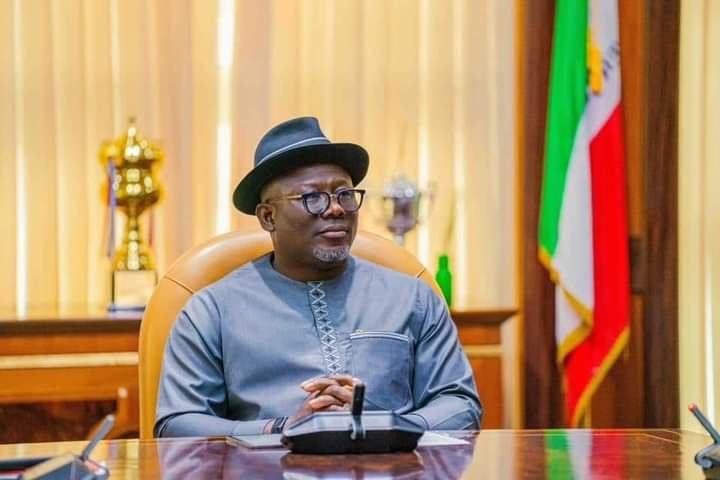
Delta State Governor, Sheriff Oborevwori, on Wednesday presented the 2026 Appropriation Bill to the state House of Assembly, describing it as a responsive and forward-looking budget anchored on fiscal discipline and economic transformation.
Tagged: “Budget of accelerating the MORE Agenda,” the 2026 proposal succeeds the 2025 fiscal plan christened: “Budget of physical consolidation.”

Gov. Oborevwori disclosed that the 2026 budget stands at ₦1.664 trillion, comprising ₦499 billion for recurrent expenditure (30%), and ₦1.165 trillion for capital expenditure (70%).
This represents a marked expansion from the 2025 budget and a stronger push toward infrastructure development, human capital growth, and strategic investments across the state.
He urged the assembly to give the proposal full legislative backing, emphasizing that the budget is designed to deepen the administration’s agenda and fast-track sustainable development.
The governor highlighted the state’s expenditure performance from January to October 2025, disclosing that recurrent spending stood at N340.55 billion, equivalent to 117 percent performance, while capital expenditure totaled N509.78 billion, representing 97 percent performance.
He attributed the impressive performance to improved federal allocation receipts following subsidy removal and fiscal reforms undertaken by both federal and state governments.
The governor explained that the budget will be funded through statutory allocation, mineral derivation revenues, internally generated revenue, VAT receipts, other capital receipts, and savings from oil revenue recoveries.
Statutory allocation is projected at N720 billion, while internally generated revenue is expected to rise to N250 billion due to ongoing reforms targeted at blocking leakages and modernizing tax administration.
VAT receipts are projected at N120 billion, while capital receipts have been deliberately reduced from N92 billion in 2025 to N25 billion in 2026 in line with the government’s commitment to zero borrowing.
Read Also:
- Gov. Oborevwori felicitates O’tega Emerhor @ 68
- Keeping the south safe is critical to Nigeria’s stability, Gov. Oborevwori tells naval chief
- Delta widows laud Gov. Oborevwori for payment of October stipends
Oil revenue recoveries and savings are expected to contribute N489 billion to the budget.
Gov. Oborevwori outlined the allocation to key sectors. For road infrastructure, the government is proposing N450 billion to fund major road and bridge projects across urban, rural, and riverine communities.
In the education sector, a total of N105.086 billion has been earmarked to enhance teaching and learning facilities and strengthen access to quality education.
The health sector is set to receive N50.067 billion to support primary, secondary, and tertiary health institutions across the state.
To support rapid urbanisation and ease the pressure on infrastructure in Asaba, the Delta State Capital Territory Development Agency is allocated N20 billion, while another N20 billion is earmarked for the Warri, Uvwie, and Environs Development Agency to sustain the ongoing renewal of Warri and surrounding areas.
The Ministry of Energy will receive N16 billion to drive the multi-grid electricity framework aimed at strengthening the state’s power supply.
The Ministry of Agriculture and Natural Resources will get N10 billion to boost food production and support agricultural value chains, while the sum of N20 billion is set aside for social protection programmes aimed at reducing poverty and improving livelihoods.
Additionally, a local government intervention fund of N100 billion has been created to address unique infrastructural and community needs across the 25 local government areas.
On security, the governor restated his administration’s commitment to sustaining peace and safety across the state.
He said investments would continue in surveillance technology, including drones and intelligence-gathering equipment, alongside support for security personnel and logistics.
Gov. Oborevwori commended the state House of Assembly for its cooperation and urged the legislators to give the budget accelerated consideration.
After the presentation, the Speaker of the House, Emomotimi Guwor, commended to governor for his developmental strides in the state.
He pointed out that the governor has kept to the tenets of governance, which guarantee separation of powers, promising that the House will expedite action on the bill.
The speaker therefore directed that the Appropriation Bill be taken for first reading, which the House adopted.
He subsequently fixed Thursday, November 27, 2025, for the second reading of the bill.