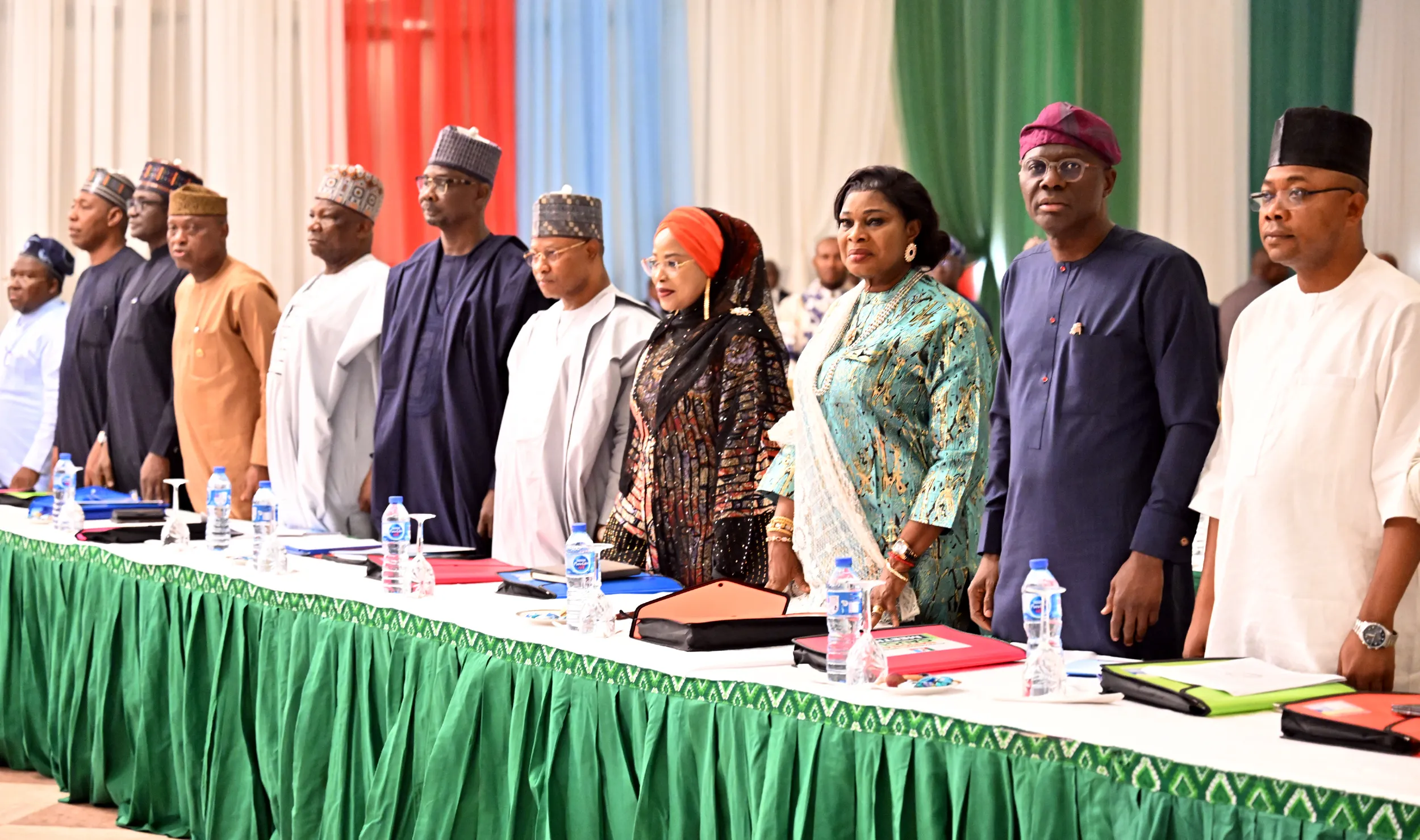
The All Progressives Congress held its 14th National Caucus meeting on December 18 at the State House Conference Centre, Abuja, in a gathering that underscored the party’s growing dominance and set the tone for its strategy ahead of the 2027 general elections.
Presided over by President Bola Ahmed Tinubu, the meeting marked the first caucus session under the leadership of the new National Chairman, Professor Nentawe Yilwatda. It attracted top-ranking party leaders and power brokers, reflecting a renewed drive for unity, consolidation, and internal coordination amid sweeping political realignments.

In attendance were Vice President Kashim Shettima, former Vice President Yemi Osinbajo, Senate President Godswill Akpabio, Speaker of the House of Representatives Tajudeen Abbas, Deputy Senate President Jibrin Barau, and Deputy Speaker Benjamin Kalu. Serving and former APC governors, members of the National Working Committee, senior stakeholders, and officials of the Independent National Electoral Commission were also present as observers. President Tinubu arrived at 7:38 p.m., shortly before deliberations began.
The atmosphere was shaped by the presence of several governors who recently defected from the Peoples Democratic Party, including Siminalayi Fubara of Rivers, Peter Mbah of Enugu, Sheriff Oborevwori of Delta, Douye Diri of Bayelsa, Umo Eno of Akwa Ibom, and Agbu Kefas of Taraba. Their attendance at their first APC caucus meeting signalled a widening shift in Nigeria’s political landscape. Former PDP heavyweights such as Ifeanyi Okowa, Anyim Pius Anyim, and Ken Nnamani were also present, reinforcing perceptions of a steady migration into the ruling party.
APC National Chairman, Yilwatda described the meeting as a moment of renewed confidence, praising party cohesion and the collective backing for President Tinubu’s economic and governance reforms. He said the APC had assumed a stabilising role in national politics, building on the legacy of the Buhari-Osinbajo administration while forging a broader consensus within the party.
One of the most striking announcements of the night was the formal declaration of Plateau State Governor Caleb Mutfwang’s defection to the APC. Yilwatda, who contested against Mutfwang in the 2023 governorship election, described the move as historic, noting that it gives the APC full control of the North-Central geopolitical zone. He added that the cumulative effect of recent defections has handed the party an overwhelming majority in the National Assembly.
Read also:
- APC confirms defection of Plateau Governor Mutfwang, from PDP
- Progressive Igbo groups reaffirm Tinubu’s commitment to South-East development
- Fintiri Presents ₦583.33bn 2026 budget to Adamawa Assembly
President Tinubu used the caucus to press for key governance reforms, calling on all governors to comply with the Supreme Court ruling on local government autonomy by ensuring that statutory allocations are released directly to councils. He insisted that autonomy must be backed by funding and urged state leaders to deepen grassroots governance.
The president also renewed his call for the establishment of state police as a response to Nigeria’s security challenges and assured international partners of the country’s commitment to the reform. He further advocated increased female participation in party leadership, stressing the need to address gender imbalance in decision-making structures.
On party organisation, Yilwatda announced January 30, 2026, as the deadline for the completion of the APC’s nationwide electronic membership registration. The digital exercise, he said, is designed to strengthen transparency, improve data integrity, and enhance internal democracy ahead of future congresses. Preparations for the February 21, 2026, Federal Capital Territory local government elections and ongoing constitutional amendments coordinated by Yobe State Governor Mai Mala Buni were also discussed, alongside plans for a new national secretariat in Abuja.
The caucus also observed a moment of condolence, with President Tinubu expressing sympathy to the Bayelsa State Government over the death of its deputy governor. Leaders reaffirmed their commitment to party discipline, strategic review, and cohesion as preparations intensify for future electoral contests.
With control consolidated across key regions and momentum driven by high-profile defections, the APC left the caucus projecting confidence and readiness. Party leaders said the meeting reaffirmed their resolve to back Tinubu’s agenda on security, local governance, and institutional reform, positioning the APC as the central force in Nigeria’s political equation ahead of 2027.