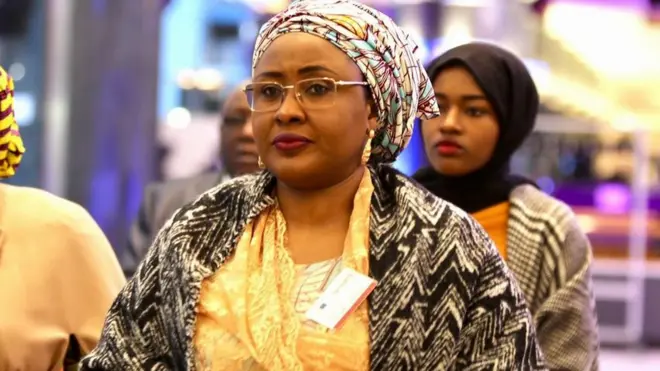
Former First Lady Aisha Buhari has disclosed that rumours within the Presidential Villa alleging she planned to kill her husband, the late President Muhammadu Buhari, deeply unsettled him and disrupted a carefully managed health routine, ultimately contributing to the medical crisis that kept him away from office for 154 days in 2017.

Her account is contained in a newly released 600 page biography titled From Soldier to Statesman: The Legacy of Muhammadu Buhari, written by Dr Charles Omole and launched on Monday at the State House, Abuja. The 22 chapter book traces Buhari’s life from his childhood in Daura, Katsina State, to his final days in a London hospital in mid July 2025.
According to the biography, Aisha Buhari had long supervised her husband’s feeding schedule and supplements, a routine she said was essential for sustaining a “slender man with a long history of malnutrition symptoms.” She maintained that Buhari did not suffer from any mysterious or chronic illness, insisting instead that his health depended largely on consistency and proper nutrition.
She recalled repeatedly telling those around him that elderly bodies required gentle and regular support, adding that keeping him on a strict schedule was key to maintaining his strength. The former First Lady said the problem began after the family moved from Kaduna to Aso Rock, where the presidency’s complex machinery gradually took over their private lives.
In the book, Mrs Buhari explained that the routine involved carefully timed meals and supplements, including tailored vitamin powders, oils, modest protein portions, and adjusted cereals. She said she convened a meeting with senior aides, including Buhari’s physician, Dr Suhayb Rafindadi, the Chief Security Officer, Bashir Abubakar, the housekeeper, and the Director General of the Department of State Services, to outline the plan and ensure strict adherence.
Read also:
- Lamido says he’s open to alliances as PDP crisis deepens
- Supreme Court backs Tinubu’s authority to declare emergency rule, suspend elected officials
- Gov. Okpebholo launches 2026 Armed Forces Remembrance Emblem Fund with ₦10m
However, the arrangement soon collapsed amid what she described as fearmongering and damaging gossip. According to her account, rumours spread within Aso Rock that she intended to poison the President. She said Buhari believed the claims for a brief period, became suspicious, began locking his room, altered daily habits, and most critically, missed meals while supplements were discontinued.
The former First Lady said Buhari was initially frightened and reluctant to take the prescribed nutrition. She then quietly resumed control of his care, discreetly adding hospital issued supplements to his juice and oats. She described the recovery as rapid, noting that within three days he abandoned the walking stick he had been using and within a week was strong enough to receive visitors and relatives.
“That was the beginning, and also the reversal, of his sickness,” she was quoted as saying in the book.
Omole also addressed long-standing criticism over Buhari’s frequent medical trips to the United Kingdom, which many Nigerians viewed as an indictment of the country’s health sector. He argued that a more humane interpretation acknowledged the reality that a man in his seventies, after decades of national service, might require specialised care not easily accessible in Nigeria due to years of underinvestment.
The author further noted that Buhari consistently transferred power to his deputy during periods of medical absence, a practice he said preserved institutional order and constitutional propriety even in moments of personal crisis.
The biography also paints a picture of deep mistrust within the Presidency. Mrs Buhari alleged that the President’s office was bugged, that private conversations were monitored and replayed, and that an atmosphere of fear and guilt weighed heavily on him, contributing, in her words, to his eventual death.
She also dismissed as baseless the long circulating rumour that Buhari had been replaced by a body double popularly known as Jibril of Sudan. According to her, poor strategic communication by the government allowed routine developments to spiral into conspiracy theories that shaped public perception for years.
The revelations offer a rare and intimate glimpse into the personal toll of power, secrecy, and suspicion at the highest level of Nigeria’s government, shedding new light on one of the most debated episodes of Buhari’s presidency.