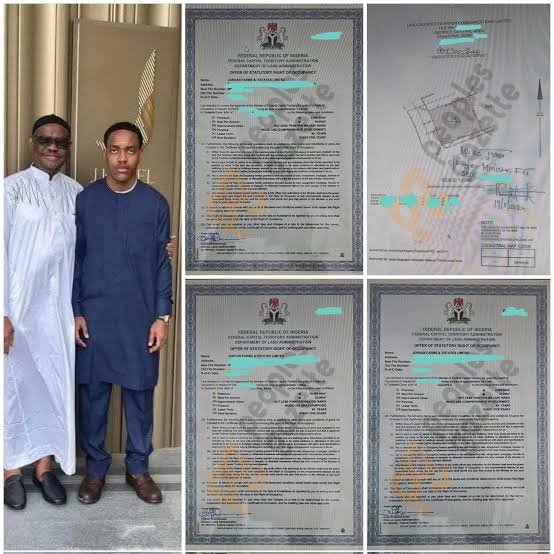
A $2.1 million cash payment allegedly made in a disputed Abuja real estate deal involving Jordan Wike has raised questions about the transaction’s purpose, the structure of the joint venture and the decision to use physical cash. The court has yet to determine the facts.
The dispute is before the FCT High Court in Abuja, where claimants Safwan Garba GY and his company, GY Global Oil and Gas Nigeria Limited, allege that they entered into a real estate arrangement with Jordan Ezenwo Nyesom-Wike, son of FCT Minister Nyesom Wike. Jordan denies the alleged deal, receipt of the money and the authenticity of documents bearing his signature.

Key Highlights
- The claimants allege they paid Jordan Wike $2.1 million in cash in October 2025.
- The parties have conflicting accounts of whether the payment was for a real estate joint venture or a land facilitation arrangement.
- The claimants say the money represented part of their proposed development contribution.
- Jordan denies receiving the money and alleges that his signature was forged.
- The case is before the FCT High Court, with further hearings scheduled for December 1, 2 and 14, 2026.
- The court has not established whether the alleged payment occurred or determined the purpose of the transaction.
Background of the Jordan Wike Abuja Land Dispute
The civil suit, numbered CV/008/2026, is before Justice Sylvanus Oriji of the FCT High Court.
The claimants allege that they entered into a real estate joint venture with Jordan in 2025. However, reports have presented two versions of the alleged arrangement, raising questions about the proposed land size, the purpose of the payment and the terms of the deal.
Claimants’ Joint Venture Account
According to the claimants’ lawyer, Ibrahim Waru, following the October 20, 2026 hearing, the proposed joint venture involved approximately 1.7 hectares in Guzape Extension and 1.5 hectares in Katampe New Extension, giving a combined area of about 3.2 hectares.
Under this account, the claimants were to contribute $4.2 million, reportedly equivalent to about ₦6.3 billion at the time, towards the construction of houses. One version of the proposal referred to 24 six-bedroom duplexes.
The proposed profit-sharing arrangement would allocate 60 per cent to the claimants and 40 per cent to Jordan. Apostle Associate Limited and Creekstone General Contractor Ltd were also named in connection with the arrangement.
The claimants allege that they paid $2.1 million, representing half of their proposed contribution, on October 17, 2025, at a residence in Gwarinpa, Abuja. They say Jordan signed an acknowledgment of receipt, with his National Identification Number and other details attached to the document. Witnesses allegedly helped carry the cash to a vehicle.
They further claim that the arrangement subsequently collapsed.
These allegations have not been established by the court.
An Earlier Account Describes a Land Facilitation Fee
An earlier version of the allegations, also reflected in the claimants’ petition to the Economic and Financial Crimes Commission (EFCC), described the $2.1 million as a facilitation fee.
Under that account, Jordan allegedly promised to facilitate the allocation of 30 hectares each in Katampe and Guzape, amounting to 60 hectares. The alleged payment was reportedly divided into $2 million intended for his father and $100,000 for himself.
The claimants also alleged that Jordan said his father had approved the arrangement and that he called the minister in their presence. They maintain that the land was not delivered after the payment and that communication subsequently ceased.
Waru has reportedly disputed the 60-hectare account, maintaining that the operative arrangement concerned the smaller parcels under the joint venture and a $4.2 million development contribution.
The two accounts differ materially. The court will need to assess the relevant documents, testimony and other evidence to determine what arrangement, if any, existed between the parties.
Why Would a Developer Pay $2.1 Million to a Land Partner?
One of the central questions raised by the allegations is why a financier in a real estate joint venture would pay a substantial amount of development capital directly to the land partner in cash.
In a conventional property development joint venture, the landowner contributes land as equity, while the developer or financier provides funds for construction and related expenses. Depending on the agreement, the money may be paid directly to contractors and suppliers or managed through a dedicated project account.
The landowner typically receives an agreed share of the project’s proceeds or completed properties. However, joint ventures can be structured differently, including arrangements involving upfront payments, land acquisition costs or other agreed consideration.
The claimants’ position, as described by their lawyer, is that the $2.1 million represented part of their own contribution to the business and that Jordan acknowledged receiving it.
If established, that account would raise questions about how the payment fitted into the proposed joint venture and what contractual obligations applied to each party.
Several issues require clarification:
- Purpose of the payment: Was the money intended for construction, land acquisition, a premium or another purpose?
- Payment structure: Why was the alleged contribution handed directly to the land partner rather than paid into a project account or used to meet development expenses?
- Documentation: What do the alleged acknowledgment, joint venture documents and other records show about the transaction?
- Security and accountability: What safeguards, if any, were in place to protect the parties’ contributions and ensure that the project proceeded?
The answers depend on the actual agreement and the evidence before the court.
The distinction is particularly important because the earlier facilitation-fee account differs significantly from the joint venture explanation. Whether the alleged payment was development capital, a fee for facilitating access to land or something else remains unresolved.
Why Was the Alleged $2.1 Million Payment Made in Cash?
The claimants allege that Jordan insisted on payment in US dollars in physical cash rather than by bank transfer, reportedly on the grounds that it would speed up the project.
They say the handover took place at a private residence in Abuja in the presence of witnesses. Jordan denies receiving the money.
The alleged use of cash raises practical and regulatory questions, particularly given the amount involved.
Cash Payments and Financial Regulation
Nigeria’s anti-money laundering framework imposes reporting and compliance obligations on covered institutions and relevant transactions. The legal treatment of a particular cash payment depends on the applicable law, the parties involved, the transaction’s circumstances and any relevant exceptions.
A large cash transaction can attract scrutiny over the source of funds, the identity of the parties, the purpose of the payment and compliance with applicable reporting requirements. However, the amount alone does not establish that a transaction was illegal or involved money laundering.
The specific legal provisions applicable to the alleged October 2025 transaction would need to be assessed before reaching a conclusion about compliance.
The Risks of Physical Cash
A transaction involving $2.1 million in physical cash would present substantial logistical and security challenges. It could also make independent verification more difficult than a properly documented bank transfer.
Electronic transfers and regulated project accounts generally provide records that can help establish the date, amount, sender and recipient of a payment. A cash transaction may instead depend more heavily on receipts, witnesses, records of the source of the funds and other evidence.
The claimants’ allegation that cash was requested is therefore relevant to the court’s assessment of the transaction. It does not, on its own, prove that either party acted unlawfully.
Jordan Wike Denies the Allegations
Jordan’s defence is a denial of the claimants’ account. He maintains that he did not enter into the alleged arrangement, did not receive the $2.1 million and did not sign the disputed documents.
He has also disputed the authenticity of the signature attributed to him and denied knowing certain individuals reportedly connected with the transaction.
During court proceedings, Jordan reportedly presented his United States passport in support of his account that he was outside Nigeria, travelling on a British Airways flight, around a date initially cited by the claimants.
The significance of the passport and the other evidence will depend on how they relate to the disputed date, documents and alleged payment. The court has yet to resolve these competing claims.
Read also:
- Wike’s Son Ordered To Produce American Passport In $2.1m Abuja Land Dispute
- 2027 Polls: Stop Your Attacks On Amaechi, ADC Chieftain Tells Wike
- Wike Questions Peter Obi’s 2027 Chances, Says Presidential Election Will Differ From 2023
EFCC Petition and Next Court Dates
The claimants have petitioned the Economic and Financial Crimes Commission (EFCC) over the allegations. The commission has reportedly acknowledged receipt of the petition, although no public enforcement action was identified in the reports referenced in the account of the dispute.
The claimants have also sought a transfer of the case over concerns about alleged judicial bias. Those concerns and the underlying allegations remain matters to be addressed through the appropriate legal process.
The case has been adjourned to December 1, 2 and 14, 2026, for further proceedings.
The scheduled dates may provide an opportunity for the parties to present additional evidence and for the court to examine the disputed transaction. The outcome will depend on the evidence and applicable law.
What the Abuja Land Dispute Could Mean for Real Estate Joint Ventures
The case highlights the importance of clear contracts, verifiable payments and safeguards in high-value property transactions.
A well-documented real estate joint venture should specify each party’s contribution, ownership interests, payment arrangements, project responsibilities, profit-sharing formula and remedies if the agreement fails. Where land is involved, parties also need to establish the relevant ownership rights, title status and any approvals required for the proposed development.
Independent legal advice, appropriate due diligence and traceable payment channels can help reduce disputes and protect the interests of all parties.
The public interest in this case has also been heightened by Jordan’s family connection to the FCT minister. Nevertheless, the allegations must be distinguished from established facts, and the parties’ rights should be determined through due process.
The central question remains whether the alleged $2.1 million payment was made, what it was intended to cover and whether the parties entered into an enforceable agreement. Until the evidence is tested, neither the claimants’ account nor Jordan’s denial should be treated as a judicial finding.
For updates on the Jordan Wike Abuja land dispute as the case returns to court, follow us on X.