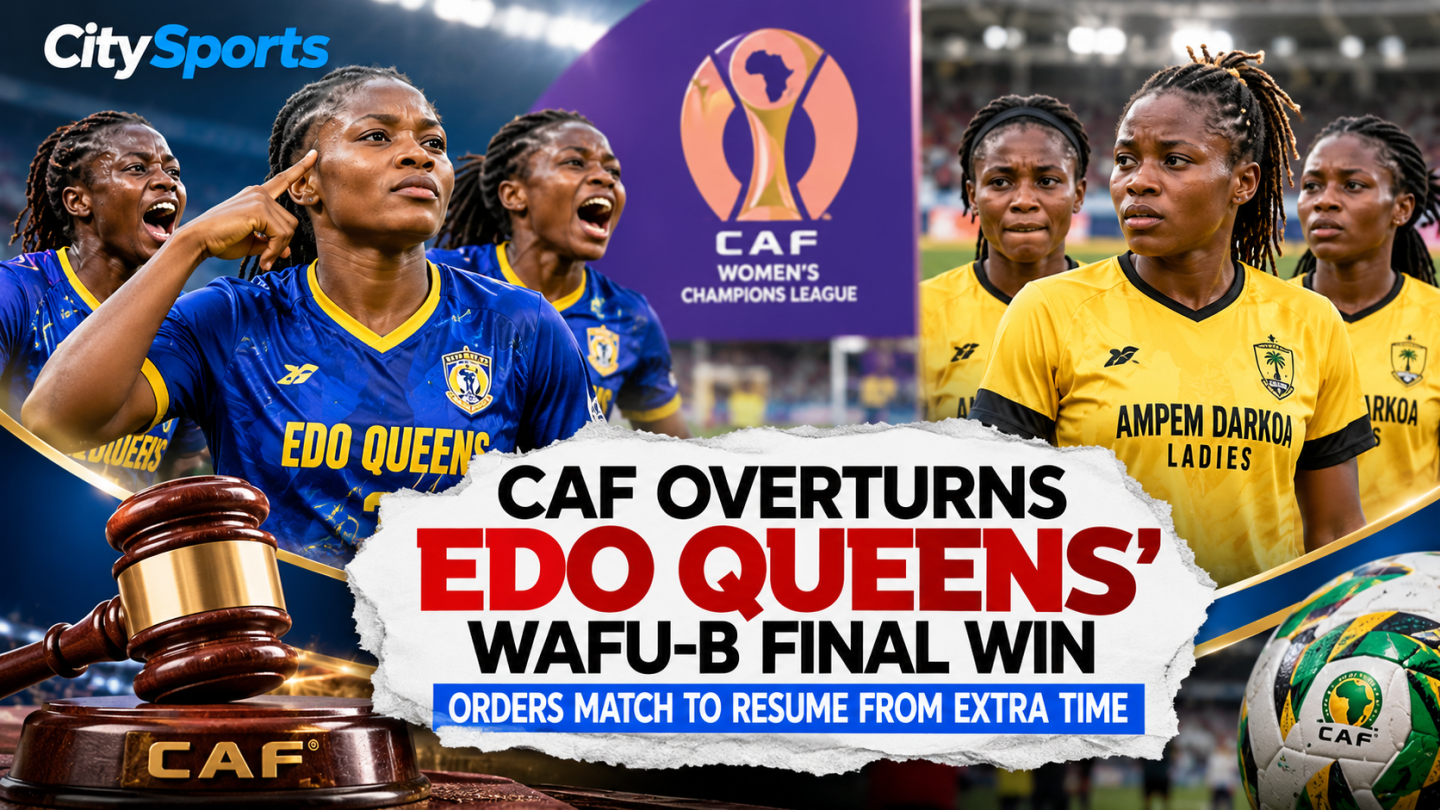
The Confederation of African Football (CAF) has torn up Edo Queens’ dramatic penalty-shootout victory over Ghana’s Ampem Darkoa Ladies, ordering the WAFU Zone B Women’s Champions League qualifying final to resume from extra time after ruling that the decisive shootout should never have taken place.
The decision has effectively reopened a final Edo Queens thought they had won on September 5 at the 4th of August Stadium in Ouagadougou, Burkina Faso, when the Nigerian champions defeated Ampem Darkoa 4-1 on penalties after the match ended 2-2 following 90 minutes.

CAF’s Organising Committee for Women’s Football, in a decision dated September 26, 2026, annulled the penalty-shootout result after upholding a protest filed by the Ghana Football Association (GFA) on behalf of Ampem Darkoa.
Rather than confirming Edo Queens as winners, CAF ruled that the match must resume at the beginning of extra time with the score still 2-2.
The teams are now required to play two 15-minute periods of extra time. If they remain level after the additional 30 minutes, a fresh penalty shootout will determine the winner and the WAFU Zone B representative at the 2026 CAF Women’s Champions League final tournament.
Read Also:
- UEFA, Concacaf Demand Release Of $10m Each Member Association From $6bn FIFA Reserves
- NFF Relaunches CAF A-License Coaching Course in Nigeria After Nine-Year Hiatus
- Nigeria Revives CAF A-License Coaching Course After 9-Year Break
At the centre of the controversy is the procedure used after the final ended 2-2 in regulation time. Instead of playing extra time, the match officials proceeded directly to penalties, with Edo Queens winning the shootout 4-1.
The Ghana Football Association subsequently protested, arguing that the direct move to penalties violated Articles 13.1 and 72.4 of the CAF Women’s Champions League Regulations.
Article 72.4 requires a drawn final to proceed to two 15-minute periods of extra time before penalties can be used to determine the winner.
CAF also relied on Article 13.1, which extends the applicable technical criteria for the final tournament to the zonal qualifying competitions.
CAF consequently determined that the procedure used in the Edo Queens-Ampem Darkoa final did not comply with the competition regulations.
In a significant aspect of the ruling, CAF found that neither Edo Queens nor Ampem Darkoa was responsible for the failure to play extra time.
According to the decision, match officials had initially been informed that extra time would be played if the final remained level after 90 minutes.
However, during the second half, the referee was subsequently instructed to proceed directly to a penalty shootout if the scores were level at full-time.
The referee followed that instruction in good faith, leading to the penalty shootout that Edo Queens won 4-1.
CAF therefore attributed the problem to an administrative instruction that was inconsistent with the competition regulations rather than to an action by either participating club.
Although reports have described the decision as a replay, CAF has specifically ruled against starting the final all over again.
Ampem Darkoa had initially sought a complete replay, or alternatively for the match to resume from the 2-2 scoreline with extra time played before penalties if necessary.
CAF rejected the full-replay option because the original 90 minutes had been validly played.
The committee concluded that there was no evidence that the conduct of the first 90 minutes had been affected by an irregularity serious enough to invalidate the entire game.
Instead, CAF chose what it considered a correction of the procedural error: preserve the valid 2-2 scoreline and play the missing extra time.
The ruling means the 4-1 penalty victory that appeared to send Edo Queens into the 2026 CAF Women’s Champions League final tournament no longer has sporting effect.
CAF has annulled the penalty shootout and its result, leaving the original 2-2 scoreline after 90 minutes intact.
The Nigerian champions must therefore return to the competition with Ampem Darkoa and complete the final from the point where the regulations were not followed.
If neither side breaks the deadlock during the two 15-minute extra-time periods, the players will face another penalty shootout.
This time, however, the shootout will come only after the required 30 minutes of extra time.
CAF has also directed that, as far as practically and legally possible, the continuation should take place under the same sporting conditions that existed at the end of the original 90 minutes.
That includes the players who were on the pitch at the final whistle, eligible substitutes who remained available, the disciplinary status of players and officials, substitutions already made and the number of substitutions remaining for both teams.
CAF has further directed that the same venue be used, subject to confirmation by WAFU Zone B, while the same match officials are expected to oversee the continuation.
WAFU Zone B will determine and communicate the date, kick-off time and venue in consultation with CAF, the GFA and the Nigeria Football Federation (NFF).
The ruling has now placed the NFF at the centre of the unfolding controversy involving Edo Queens, the reigning Nigerian champions.
The federation is expected to engage CAF over the decision, particularly because CAF itself acknowledged that neither Edo Queens nor Ampem Darkoa caused the procedural error that triggered the dispute.
The development has also attracted criticism from Nigerian football stakeholders.