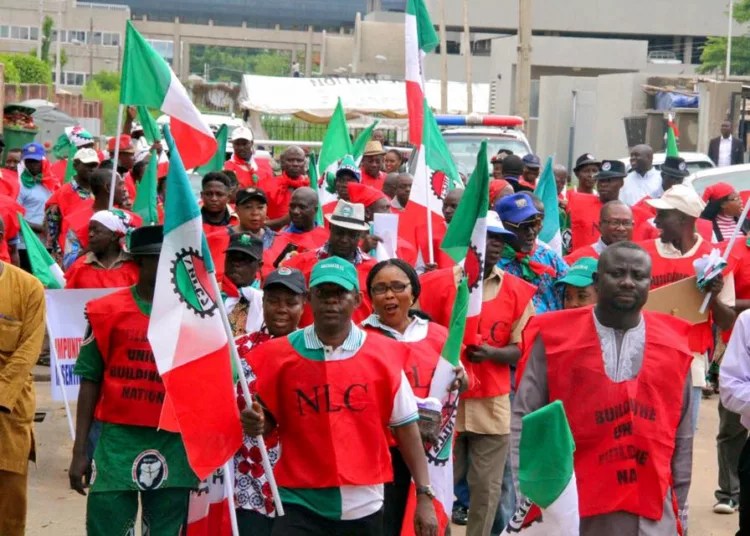
The President of the Nigeria Labour Congress (NLC), Joe Ajaero, has said Nigeria is still being governed without a coherent development plan, energy policy or food policy, 66 years after gaining independence.
Ajaero said successive governments had failed to produce a clear roadmap for managing the country’s economy and development, arguing that Nigeria’s policies are largely determined by individuals rather than a nationally agreed plan.

He spoke on Sunday during a webinar organised by the Workers’ Rights Campaign (WRC) and Elegant Nurses Forum to commemorate Nigeria’s 66th Independence anniversary.
The webinar, anchored by WRC Secretary Baba Aye, was themed, “The Working Class in Nigeria: Sixty-Six Years After Independence.”
The General Secretary of the Federation of Informal Workers’ Organisations of Nigeria (FIWON), Gbenga Komolafe, was the other lead speaker.
Key Highlights
- NLC President Joe Ajaero says Nigeria has no coherent development plan, energy policy or food policy 66 years after independence.
- He argues that policies are driven by individuals rather than a nationally agreed plan.
- Ajaero contrasts the current situation with the early post-independence 10-year development plan.
- He calls for national debate on major economic policies and a living wage linked to essential costs.
- FIWON’s Gbenga Komolafe says Nigeria’s informal economy accounts for about 93% of the active working population.
- Both speakers urge industrialisation, formalisation and stronger organisation of workers.
Ajaero contrasted Nigeria’s current situation with the early years of independence, when the country had a 10-year development plan that outlined targets for infrastructure, including electricity generation, roads, railways and universities.
“Today, what is the development plan of Nigeria? Nigeria is being run from people’s heads,” Ajaero said.
He added, “We don’t have our policy on energy, no policy on food supply, no policy, no white paper on it.”
The NLC president also criticised the government’s reluctance to subject major economic policies to national debate.
He recalled that even under the military government of former Head of State Ibrahim Babangida, Nigerians were allowed to debate the country’s political system and make recommendations.
“We have a government that can’t send any of their ministers, other ministers of economy or even petroleum, to say, hey, let there be a national debate on this issue,” he said.
Ajaero said organised labour wants the government to clearly state how it intends to manage the economy so that wage negotiations can be tied to a broader economic framework.
He also traced the history of the Nigerian working class to the colonial period, citing major labour struggles such as the 1945 general strike and the 1949 Iva Valley shooting.
According to him, the 1945 strike demonstrated the ability of workers to disrupt economic activities and force governments to respond to their demands.
He said the 1964 general strike was similarly triggered after political office holders increased their own salaries between 1960 and 1963 while public servants’ wages remained unchanged.
Ajaero said the strike, which involved about four labour centres and more than 800,000 workers, shut down the country for almost 12 days.
He, however, said the unity among workers was later weakened by the civil war, with workers who opposed the conflict on class-conscious grounds allegedly facing victimisation.
According to Ajaero, many of the struggles faced by Nigerian workers over the years have centred on wages, petroleum pricing, inflation and political participation.
He accused the country’s ruling elite of maintaining an economic structure in which Nigeria continues to export raw materials and import finished products.
Ajaero specifically cited crude oil, arguing that Nigeria produces crude, sends it abroad for refining and then imports petroleum products.
“We remain a consumer economy where our political class will always conspire even to refine their products either in UK or US or in France and then bring back to us,” he said.
He argued that increasing workers’ salaries without addressing the structural causes of inflation would provide only temporary relief.
According to him, even if the minimum wage were increased to N100 million, inflation would eventually erode its value if the factors driving inflation remained unresolved.
Read also:
- Seyi Makinde Says Nigeria Can Be Reset in Four Years If Elected President
- Clean Sweep In Enugu And Yobe: How APC Just Turned LG Polls Into A 2027 Warning
- HURIWA Demands Proof Of ₦600bn FG’s Cash Transfer, Raises Alarm Over Plateau, Zamfara Attacks
Meanwhile, Komolafe said Nigeria’s informal economy had grown to an “embarrassingly” high level, accounting for about 93 percent of the active working population between ages 16 and 65, according to figures he attributed to the National Bureau of Statistics.
He said the figure was significantly higher than the African average of about 32 percent.
Komolafe attributed the expansion of informality to Nigeria’s weak productive capacity, loss of formal-sector jobs and the historical structure of the economy.
He said traditional occupations such as blacksmithing, carpentry and other crafts had historically operated informally, while economic policies and the loss of industrial jobs had pushed more Nigerians into the informal sector.
“It’s a symptom of underdevelopment. It’s a symptom of retrogression. It’s nothing to celebrate,” Komolafe said.
He said the growth of the informal economy reflected a decline in Nigeria’s productive capacity rather than an economic achievement.
Komolafe also said workers’ wages in the formal sector had a direct impact on informal workers because low wages reduce the purchasing power available to patronise local businesses.
He said FIWON was seeking policies that would promote formalisation through industrialisation rather than “glamourising” the informal economy.
He called for access to basic technology, properly equipped work clusters and social protection, including health insurance, maternal care and old-age support, for workers who remain in the informal sector.
Ajaero, for his part, called for a national debate on Nigeria’s economic direction and the development of a comprehensive plan that would address the structural causes of inflation.
He advocated a living wage linked to the cost of essential needs such as transportation, food, housing and education.
He also called for shorter wage review cycles of two to three years rather than five years.
The NLC president urged workers to unite across ethnic and religious lines, defend their rights through the courts and industrial action, and build a grassroots-oriented Labour Party funded through regular membership dues rather than wealthy individuals.
Komolafe similarly called for greater cooperation between the NLC and FIWON to organise informal workers and push for policies aimed at industrialisation and formal employment.
The webinar was attended by labour activists, unionists and other stakeholders, including human rights lawyer Femi Falana, SAN. For more labour and political updates, follow us on X.