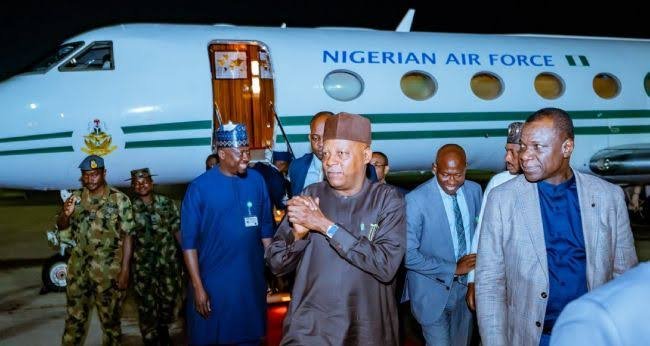
Vice President Kashim Shettima has returned to Nigeria after representing President Bola Tinubu at the 18th BRICS Leaders’ Summit in New Delhi, India.
Key Highlights
- Vice President Kashim Shettima returned to Nigeria after representing President Bola Tinubu at the 18th BRICS Leaders’ Summit in New Delhi.
- Shettima held bilateral talks with Indian Prime Minister Narendra Modi on strengthening economic cooperation between Nigeria and India.
- Discussions covered crude oil trade and investments in pharmaceuticals, defence, fintech, digital technology and renewable energy.
- The Vice President met WTO Director-General Ngozi Okonjo-Iweala on multilateral cooperation and reforms to the global economic system.
- Shettima conveyed Nigeria’s call for reforms to global governance structures and international financial institutions.
Shettima’s participation at the summit featured high-level diplomatic engagements and bilateral discussions focused on expanding Nigeria’s trade, investment and technology partnerships with major emerging economies.

During his visit, the vice president held talks with Indian Prime Minister Narendra Modi on opportunities to strengthen economic cooperation between Nigeria and India.
The discussions covered renewed crude oil trade as well as potential investments in pharmaceuticals, defence, digital technology, fintech and renewable energy.
Read also:
- Dino Melaye Threatens Showdown, Warns FG Against Touching Atiku Over Corruption Petition
- Saudi Arabia Moves To Shift 98% Of Nigeria’s Hajj Quota To Private Operators
- Maternal Mortality: FG Targets 172 LGAs With Incentives To Save Mothers, Newborns
Shettima also met with World Trade Organisation (WTO) Director-General, Ngozi Okonjo-Iweala, where discussions centred on multilateral cooperation and reforms aimed at creating a more inclusive global economic system.
At the BRICS summit, the vice president conveyed President Tinubu’s position on the need to reform global governance structures and international financial institutions.
He also presented Nigeria as a strategic gateway to Africa’s growing consumer market, highlighting the opportunities offered by the African Continental Free Trade Area.
Nigeria further used the summit to strengthen engagement with BRICS member and partner countries across key sectors, including agriculture, artificial intelligence, digital infrastructure, manufacturing, healthcare, energy and human-capital development.
The engagements formed part of the Tinubu administration’s broader push to attract foreign investment, expand Nigeria’s trade relationships and position the country more prominently within emerging global economic and technology networks.