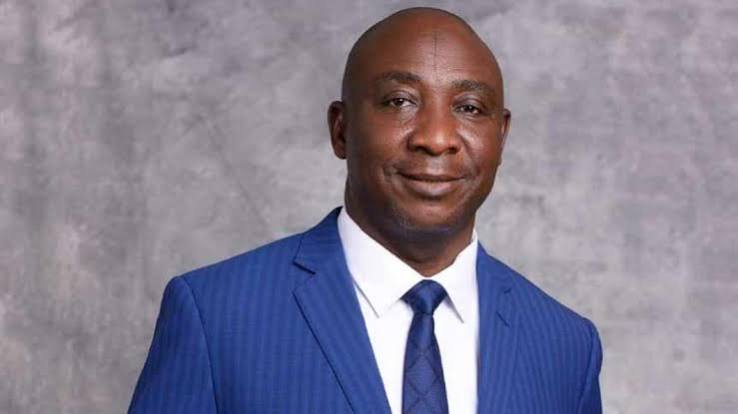
Ibrahim Musa Gusau has resigned as President of the Nigeria Football Federation (NFF), leaving Nigerian football without a substantive leader at the top of the federation as stakeholders begin discussions on an interim arrangement and fresh elections.
Gusau announced his resignation on Thursday, August 27, 2026, at the NFF Secretariat in Abuja, alongside General Secretary Mohammed Sanusi and members of the federation’s executive committee. He said the decision followed consultations with his family, friends and football stakeholders and was aimed at paving the way for “a comprehensive and orderly reform process” to address longstanding challenges in Nigerian football administration.

Key Highlights
Ibrahim Gusau has resigned as NFF President alongside the General Secretary and executive committee members.
No permanent successor has been appointed as NFF President.
Deputy General Secretary Dr Emmanuel Ikpeme is expected to handle administrative duties in an acting capacity.
An emergency NFF Congress has been convened to determine the next steps.
Stakeholders are considering an interim arrangement or normalisation committee before fresh elections.
The leadership crisis comes after the Super Eagles missed the 2026 FIFA World Cup and the Super Falcons failed to qualify for the 2027 Women’s World Cup.
Gusau Resigns Amid Football Crisis
Gusau’s resignation came less than a month before the NFF’s scheduled elective congress, which was expected to hold on September 27 in Lafia, Nasarawa State.
His departure followed growing criticism of the federation’s administration and the performance of Nigeria’s national teams.
The Super Eagles failed to qualify for the 2026 FIFA World Cup, marking their second consecutive absence from the tournament. The Super Falcons also failed to qualify for the 2027 Women’s World Cup for the first time since the competition began in 1991.
Nigeria’s age-grade teams have also faced disappointing results, adding to concerns over the country’s football development system.
The federation has further faced scrutiny over reports of investigations by security and anti-corruption agencies into the management of a multi-billion-naira government intervention fund intended to cover players’ allowances and bonuses.
Gusau said his resignation was intended to create room for a broader reform process within the federation.
Who Takes Over as NFF President?
For now, no one has been formally appointed as the new NFF President.
The resignation of Gusau, Sanusi and members of the executive committee has created a leadership vacuum that requires an interim arrangement pending a decision on the federation’s future structure.
Deputy General Secretary Dr Emmanuel Ikpeme is expected to provide administrative continuity and assume the duties of General Secretary in an acting capacity.
Ikpeme, a long-serving NFF official, was present at Gusau’s resignation press conference and has previously held senior administrative responsibilities within the federation.
His acting role, however, does not amount to an appointment as NFF President.
Read also:
Read also:
- Why I Stepped Down As NFF President – Gusau
- Senate Summons NFF, NSC Over Nigeria’s Football Crisis
- NPFL Referee Dies During Pre-Season Fitness Test In Abuja
Emergency NFF Congress to Decide Next Steps
An emergency NFF Congress has been convened in Abuja to deliberate on the implications of the mass resignations and determine how the federation will operate during the transition.
Among the issues expected to be considered are the status of the executive committee, compliance with NFF statutes and the federation’s obligations under the statutes of the Confederation of African Football (CAF) and FIFA.
One of the options being discussed is the establishment of a normalisation committee to oversee the federation temporarily and organise fresh elections.
Such an arrangement could involve FIFA and the National Sports Commission (NSC), depending on the final structure and the applicable football statutes.
The NSC has played a central role in discussions over the future of Nigerian football administration, with calls for reforms and changes to the leadership structure.
Tinubu Orders Football Administration Reforms
President Bola Tinubu’s administration has also directed that Nigeria’s football administration undergo a comprehensive reform process.
The proposed reforms are expected to address issues including governance, accountability, stakeholder representation, youth development pathways and the organisation of domestic competitions.
The government’s intervention comes at a critical point for Nigerian football, following the poor performance of the national teams and growing concerns over the management of the sport.
What’s Next for the NFF?
Several options are now under consideration as stakeholders seek to stabilise the federation.
One possibility is an interim or caretaker administration that would manage the NFF until fresh elections are conducted.
Another option is a normalisation committee, which could oversee the federation during a defined transition period and organise new elections in accordance with applicable NFF, CAF and FIFA requirements.
A broader restructuring process involving the NSC, football stakeholders and other relevant authorities is also being considered.
The key challenge will be ensuring that any transition complies with the autonomy requirements governing football associations while addressing the concerns that triggered the current crisis.
Former Players Demand Deeper Reform
Former Nigerian internationals and football stakeholders have also called for fundamental changes in the administration of Nigerian football.
Former Super Eagles stars including John Obi Mikel and Austin “Jay-Jay” Okocha, as well as football administrator and former international Segun Odegbami, have been among voices calling for deeper reforms.
The calls have centred on improving governance, accountability, football development and the management of Nigeria’s domestic competitions.
Gusau, who also served as President of the West African Football Union Zone B (WAFU B), defended aspects of his administration’s record, including efforts involving refereeing and sponsorship.
He also indicated his willingness to remain available to contribute to the development of African football based on his experience.
No Permanent NFF Successor Yet
The immediate answer to the question of who takes over as NFF President is that there is currently no confirmed permanent successor.
The resignation of Gusau and the NFF executive leadership has opened the way for an interim arrangement while the emergency congress, the NSC and other football stakeholders determine the next phase.
The outcome of those discussions will determine whether Nigeria gets a caretaker administration, a normalisation committee or another transitional structure before fresh elections.
For Nigerian football, the priority will be restoring administrative stability, strengthening governance and rebuilding confidence in the federation after a difficult period for the country’s national teams.