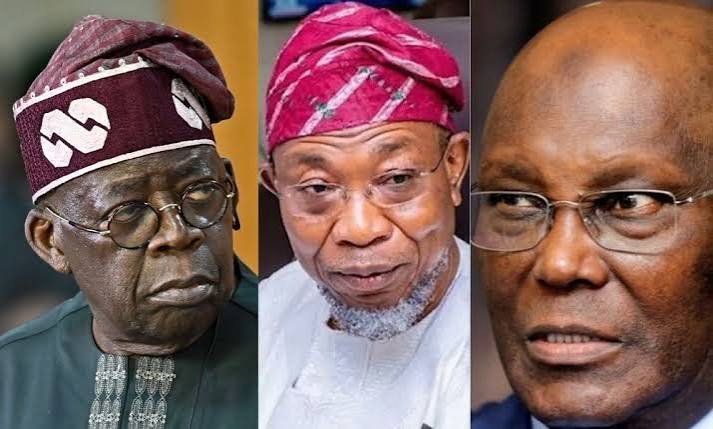
President Bola Ahmed Tinubu has revived the “Half Salary” nickname associated with former Osun State Governor, Rauf Aregbesola, while criticising former Vice President Atiku Abubakar over his proposal to review the removal of petrol subsidy if elected president in 2027.
Tinubu made the remarks on Thursday while receiving Osun State Governor, Ademola Adeleke, at the Presidential Villa in Abuja, days after Adeleke secured victory in the August 15 governorship election.

Key Highlights
Tinubu referred to former Osun Governor Rauf Aregbesola as “Half Salary.”
The President criticised Atiku Abubakar over his proposal to review the petrol subsidy policy.
Tinubu defended his decision to remove fuel subsidy in May 2023.
The President said subsidy savings should be channelled into infrastructure and public services.
Tinubu linked the former subsidy regime to difficulties faced by states in paying salaries.
Atiku has criticised the Tinubu administration’s economic policies and called for a review of the subsidy policy.
Speaking about the political situation in Osun State, Tinubu said, “In your state, I know a man that I raised who is nicknamed half salary.”
The President was referring to Aregbesola, who governed Osun State from 2010 to 2018 and was formerly a member of the All Progressives Congress (APC) and an ally of Tinubu.
Aregbesola became associated with the “Half Salary” label during his tenure after the Osun State Government faced difficulties paying full salaries to civil servants.
The former governor, who is now a chieftain of the African Democratic Congress (ADC), has since moved away from the APC political structure.
Tinubu Attacks Atiku Over Fuel Subsidy Proposal
Tinubu brought up the nickname while responding to Atiku’s position on petrol subsidy, describing the former vice president’s proposal as evidence of what he called a lack of understanding of governance and the economy.
“I saw one of my opponents, Atiku Abubakar, now say he will go back to subsidy. I read it,” Tinubu said.
The President argued that Nigeria’s financial position before his administration made the continuation of the subsidy regime unsustainable.
“That is a demonstration of a serious ignorance on governance and economy. Before I came here, 27 states were unable to pay salaries, not to even talk of pensioners, salary of workers.”
Tinubu removed the petrol subsidy shortly after assuming office in May 2023 and has repeatedly defended the decision, arguing that government resources previously spent on subsidising petrol can be redirected towards infrastructure and social services.
‘Subsidy Money Should Fund Infrastructure’
The President said the subsidy regime had contributed to the financial difficulties experienced by state governments, leaving some dependent on Federal Government support to meet salary and other obligations.
He argued that funds saved from petrol subsidy could instead be invested in roads, housing, schools, hospitals and healthcare.
“Ask common men, their families, to feed the infrastructure you embark upon on the road network, housing, school rehabilitation, hospital, health care pronouncements,” Tinubu said.
Read also:
- Governor Diri Flags Off Tinubu’s 2nd Term Campaign In South South
- Tinubu Appoints Enitan New Head of Civil Service
- Tinubu Needs More ‘Mad Men’ in Government, Ben Bruce Says
- Oyedele Admits Tinubu’s Reforms Caused Hardship But Necessary
He also listed the training of teachers and healthcare workers among areas where public resources could be deployed to improve living conditions and protect vulnerable Nigerians.
Atiku Calls for Review of Subsidy Policy
Atiku Abubakar has criticised the Tinubu administration’s economic policies and called for a review of the petrol subsidy policy.
The former vice president has argued that the government’s approach to fuel pricing and other economic reforms has placed additional pressure on Nigerians and businesses.
The disagreement over petrol subsidy is expected to remain a major issue in the political debate ahead of the 2027 presidential election, with the two political camps offering different approaches to managing fuel prices, public finances and the wider Nigerian economy.
Related Stories: