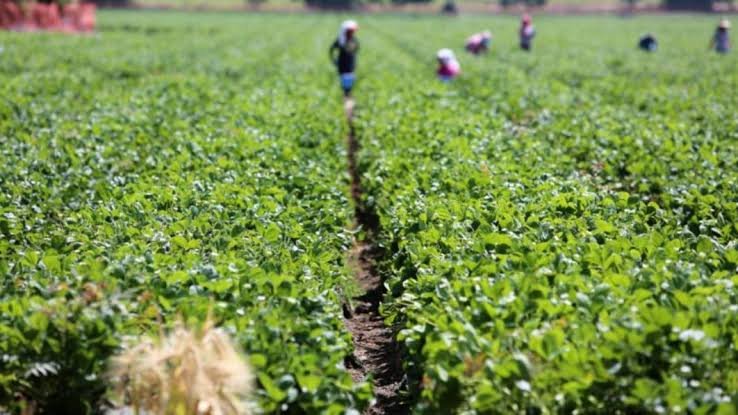
The Delta State Government has launched a youth agricultural advancement programme aimed at creating wealth, reducing unemployment and encouraging young people to venture into the production of export-oriented cash crops.
Tagged “Creating Wealth for Delta Youths Through Agricultural Advancement for Short-Term Cash Crop Export,” the programme focuses on cocoa, coffee, ginger and cotton, with plans to distribute 10,000 ginger seedlings, 10,000 cocoa seedlings, 5,000 coffee seedlings and 100,000 cotton seedlings to participants.

Flagging off the workshop, the Commissioner for Agriculture, Valentine Arenyeka, urged the youths to discard the belief that farming is for old people or does not make money.
“There is this misconception that farming is for old people and that farming does not make money. That is a myth we need to dispel,” Arenyeka said.
He said the programme, approved by Governor Sheriff Oborevwori, targets 1000 participants who would be exposed to agricultural value chains with commercial potential.
“The good thing about these value chains is that they have relatively short gestation periods. If you do it and do it well, within the next one year, you should be harvesting and selling,” he added.
Read Also:
- Police Reactivate ‘Operation VELVET’ To Boost Traffic Enforcement In Delta
- Gov. Oborevwori Presents 18-Seater Bus To Delta NUJ, Reaffirms Commitment To Media Partnership
- Delta Deputy Governor Onyeme Urges Nigerians to Support Tinubu’s Economic Reforms
Arenyeka stressed that agriculture should be approached as a business, saying “planting is just a part of it. The business of agriculture is agribusiness. We are processing, we are planting, then you go into processing, you export and increase the value of whatever products you produce.”
He urged the participants to take the training seriously, saying, “Your life will never be the same again.”
Speaking on the initiative, the Special Adviser to the Governor on Agriculture, George Oyefia, said the programme was designed to redirect youths towards agriculture, which he described as a major employer of labour.
Oyefia, who said he had been farming for 29 years and was a lawyer by profession, told the participants that academic qualifications should not prevent them from embracing agriculture.
“I am a lawyer by profession. So it doesn’t matter what you study,” he said, adding that “some of our young people have started leaving the university and are now going into farming.”
He stressed the importance of knowledge in agricultural production, saying, “Farming without knowledge, you cannot farm. A lot of people have jumped into farming and, as they are jumping in, they are jumping out.”
On land availability, Oyefia said Delta had sufficient land for agricultural activities, noting that the state has a 12,000-hectare land bank, in addition to communal and family lands.
The facilitator, Israel Yusuf, popularly known as Dr. Fish, said the programme was designed to move the state’s economy from dependence on oil to agriculture.
“The programme is meant to diversify the economy from an oil-based economy to an agri-based economy,” Yusuf said.
He explained that the selected crops were chosen because of their export value, adding, “We are moving from agriculture to agribusiness.”
Yusuf said his focus would include market access and investment readiness, explaining that participants would be taught how to package their agricultural businesses for investment.
An organiser, Blessing Akhigwe, said the programme was aimed at changing the perception that agriculture was dirty or unrewarding.
“Agriculture is not a dirty work. Agriculture is the new wealth,” she said, urging Delta youths to take advantage of the opportunities in agriculture and agribusiness.
The programme’s organisers said the combination of training, seedlings and exposure to agricultural value chains would help participants move from learning to actual production and ultimately contribute to wealth creation and economic diversification in Delta State.
One of the participants, Duchess Oghenerukevwe Ikpasa, said the programme would provide her with knowledge and experience in cocoa, coffee, ginger and cotton production.
“I have been thinking of how I can go into agriculture. Agriculture is something we need to invest in as young people,” she said.
Another participant, Kesiah Idodo, a poultry farmer, said the training would help him diversify his agricultural business.
He advised young people against the pursuit of quick wealth, saying, “There is no fast money anywhere. Take your time and build.”