
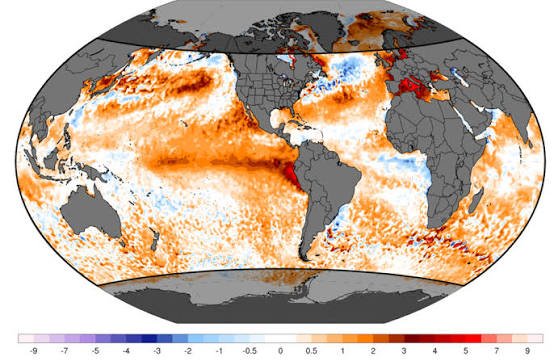
The world’s oceans recorded their hottest July temperatures ever, with scientists warning that developing El Niño conditions could push global temperatures even higher in the months ahead.
According to the European Union’s Copernicus Climate Change Service, the average sea-surface temperature between 60°N and 60°S reached 20.96°C in July 2026, surpassing the previous July record of 20.89°C set in 2023.

July was also the joint second-warmest July globally, with average temperatures about 1.47°C above pre-industrial levels.
Scientists say the record ocean temperatures are particularly worrying because oceans absorb most of the excess heat generated by greenhouse gas emissions and play a major role in regulating the Earth’s climate.
El Niño conditions are developing in the tropical Pacific and are expected to strengthen in the coming months.
The weather phenomenon is a natural warming pattern in the Pacific, but scientists say its effects are being amplified by human-driven climate change.
The combination could temporarily push global temperatures even higher.
Warmer oceans also contribute to rising sea levels because heated seawater expands. Ocean warming is estimated to account for roughly one-third of the sea-level rise recorded so far.
Read Also:
- German varsity alerts to unprecedented warming of the western Pacific Ocean
- Ecosystem restoration, sustainable mangrove conservation needed to combat pollution, natural disasters
- Maritime stakeholders, partners restate judiciary’s role in NIMASA’s fight against piracy
Scientists also warn that hotter seas are increasing the frequency and intensity of marine heatwaves, contributing to coral bleaching, damage to fisheries and the destruction of marine ecosystems.
Western Europe has experienced an exceptional period of heat, with June and July recording the highest average temperatures ever observed for the two-month period.
The average temperature across western Europe during the period was 21.62°C, about 2.79°C above normal.
France, Spain, parts of Germany and the United Kingdom have experienced exceptionally low rainfall and soil moisture, while major rivers including the Seine, Rhine and Danube have recorded unusually low water levels.
The dry conditions have increased pressure on water supplies, agriculture, transportation, energy production and aquatic ecosystems.
The prolonged heat and drought have also created ideal conditions for destructive wildfires across southern and western Europe.
Climate experts say climate change is producing hotter and drier conditions that allow wildfires to spread faster, burn more intensely and last longer.
Smoke from major fires can also travel across national borders, affecting countries far from the original wildfire zones.
The United Kingdom is also experiencing severe consequences from the prolonged dry weather.
England and Wales recorded their driest July since records began about 190 years ago, while large parts of England and all of Wales have already been declared areas of drought.
Officials have warned that additional areas could face drought declarations if dry conditions continue.
Scientists say extreme weather events that were once considered unusual are increasingly becoming part of the world’s new climate reality.
The latest developments have renewed calls for stronger climate action, better water management and greater preparedness for extreme heat, drought, wildfires and rising sea levels.
The message from scientists is clear: the climate is changing rapidly, and the consequences are increasingly being felt across oceans, cities, farms and communities worldwide.