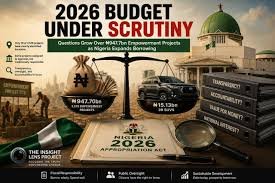
Nigeria’s 2026 federal budget was presented as a spending plan focused on economic recovery, infrastructure, security and inclusive growth. Valued at ₦68.32 trillion, the appropriation was described by the Federal Government as a blueprint for accelerating development and sustaining ongoing economic reforms.
Key Highlights
- Nigeria’s ₦68.32 trillion 2026 federal budget has attracted criticism over several controversial spending priorities.
- ₦22.15 billion was allocated for the construction, renovation and furnishing of more than 100 royal palaces nationwide.
- ₦8 billion was earmarked for projects linked to churches and mosques, triggering debate over the use of public funds for religious infrastructure.
- The ₦14 billion youth empowerment allocation was criticised for having vague project descriptions that could make accountability difficult.
- Government vehicle spending reportedly rose significantly, with ₦17.1 billion allocated across the Presidency and other government agencies.

However, beyond the headline figures, several allocations sparked widespread criticism from civil society organisations, budget analysts, professional groups and ordinary Nigerians, who questioned whether some spending priorities reflected the country’s pressing economic realities.
From billions allocated to royal palaces to controversial spending on places of worship and vaguely described empowerment projects, the 2026 budget became one of the most debated public documents of the year.
Here are six spending decisions that generated the strongest public backlash.
1. ₦22.15 Billion Allocation for Royal Palaces
Perhaps the most controversial provision in the 2026 budget was the allocation of approximately ₦22.15 billion for the construction, renovation and furnishing of more than 100 royal palaces across the country.
Transparency advocates questioned whether such projects fall within the constitutional responsibilities of the Federal Government, arguing that scarce public funds should instead be directed toward education, healthcare, security and critical infrastructure.
Civic accountability organisation Tracka described the allocations as inconsistent with government mandates and called for greater scrutiny of constituency projects.
2. Federal Funding for Religious Projects
Another contentious issue was the inclusion of allocations linked to churches and other places of worship.
N8 billion was budgeted for projects related to construction, renovation and other related support to churches and mosques across the country in the 2026 budget.
Tracka’s review showed that N1.91 billion was allocated to seven church-related projects, while N6.14 billion was set aside for 52 mosque projects in different parts of the country.
Critics argued that public funds should not finance religious infrastructure in a secular state, particularly at a time of rising inflation, unemployment and growing social needs.
Although some lawmakers defended the allocations as community development and youth engagement initiatives rather than religious projects, the explanation did little to calm public criticism.
3. ₦14 Billion for Broadly Defined Youth Empowerment Programmes
The Ministry of Youth Development received ₦14 billion for nationwide youth empowerment programmes.
While youth development itself attracted broad support, analysts questioned the absence of detailed project descriptions, locations and implementation plans.
Budget transparency advocates warned that vague budget items make public oversight difficult and reduce accountability for how taxpayers’ money is ultimately spent.
4. Increased Spending on Official Vehicles and Miscellaneous Expenses
The budget also attracted criticism over billions earmarked for official vehicles, office maintenance and miscellaneous administrative costs.
Budget documents showed significant increases in vehicle purchases and operating expenses across several government institutions, even as citizens continued to face rising living costs.
The 2026 federal budget allocated ₦17.1 billion for total government vehicle spending (a 135% increase to ₦11.25 billion for the presidency plus ₦5.85 billion for other agencies), while roughly ₦17 billion was earmarked for miscellaneous and sundry operational expenses in key bodies like the State House, EFCC, and the Nigerian Army.
#### Vehicle Allocations
₦11.25 billion for the Presidency’s vehicle purchases (up 135% from the prior year)
₦3.3 billion specifically for State House vehicle purchases and replacements (including ₦2.5 billion for new operational vehicles and ₦758 million for utility SUVs)
₦115 million for tyres designated for bullet-proof cars, platform trucks, and ambulances
₦5.85 billion across other government agencies, which includes ₦1.5 billion for luxury SUVs for federal universities.
Fiscal policy experts argued that the allocations appeared inconsistent with repeated government promises to reduce the cost of governance and promote prudent public spending.
5. Questionable and Duplicate Project Insertions
Several independent budget analysts raised concerns over duplicated projects and allocations that appeared unrelated to the statutory responsibilities of some ministries, departments and agencies.
Investigations found several instances of what appear to be overlapping and duplicate allocations in the 2026 budget. The investigation revealed that the Office of the Special Adviser on Policy and Coordination received two separate allocations of ₦1 billion and ₦2.73 billion under the Service Wide Vote, despite referring to the same office. It also found that the National Poverty Reduction with Growth Strategy was allocated ₦100 billion under the Service Wide Vote and received another similar allocation under the Ministry of Budget and Economic Planning through a different budget code. In addition, the investigation noted that Lagos liaison offices are still being funded separately by both the State House and the Office of the Secretary to the Government of the Federation (SGF), creating parallel structures despite Abuja serving as Nigeria’s capital for nearly three decades. These findings raise concerns over duplicated spending and the efficiency of public expenditure.
The concerns renewed longstanding debates over budget padding and legislative insertions in Nigeria’s appropriation process.
6. Questions Over Budget Transparency Following the PFIPC Scandal
Public confidence in the 2026 budget suffered another blow following revelations surrounding the controversial Presidential Foreign Intervention Promotion Council (PFIPC), a body that reportedly received budget allocations despite questions about its legitimacy.
The controversial budget allocation tied to the Presidential Foreign Intervention Promotion Council (PFIPC) scandal was ₦1,302,978,784
Budget Breakdown
Personnel Costs: ₦802,978,783
Overhead Expenditure: ₦200,000,001
Capital Projects: ₦300,000,000
Read also:
- 2026 Budget: FG Earmarks ₦962.83bn for SUVs, Empowerment Projects Amid Borrowing Concerns
- Ex Minister Dalung Questions ₦6.44bn Budget Allocation For Nigeria’s Already-Concluded World Cup Qualifiers
- Mixed Reactions Trail Aregbesola’s Claim He Governed Osun Without Owning a House
- Burutu Chairman, Councillors at Loggerheads as ₦2.5m Constituency Fund Deepens Council Crisis
The controversy intensified public demands for stronger budget oversight, improved verification of beneficiaries and greater transparency in the appropriation process.
Anti-corruption advocates argued that the episode exposed weaknesses in budget scrutiny and reinforced calls for comprehensive reforms in public financial management.
Growing Calls for Budget Reforms
Despite the controversies, government officials have defended the overall spending plan, arguing that the 2026 budget prioritises infrastructure, security, healthcare, education and economic growth.
The Presidency has maintained that nearly half of the budget is devoted to capital expenditure and long-term development projects intended to stimulate productivity and improve living standards.
Nevertheless, the public debate surrounding the budget has highlighted growing demands for greater fiscal discipline, clearer project descriptions, stricter oversight and stronger accountability mechanisms.
For many analysts, the controversy surrounding the 2026 Appropriation Act illustrates a broader challenge facing Nigeria’s public finance system: balancing ambitious development goals with prudent spending, transparency and public trust.
As implementation continues, many observers say success will depend not only on how much the government spends, but also on whether every naira can be justified, tracked and translated into measurable benefits for Nigerians.