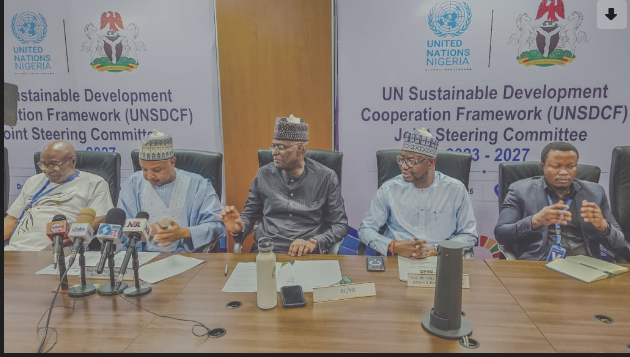
The federal government has reaffirmed its commitment to achieving the Sustainable Development Goals (SDGs) through stronger collaboration with the United Nations, development partners and other key stakeholders.
Minister of Humanitarian Affairs and Poverty Reduction, Bernard Doro, made the pledge on Monday, at the United Nations Sustainable Development Cooperation Framework (UNSDCF) 2023–2027 steering committee meeting held at the United Nations House in Abuja.

The meeting brought together ministers, senior government officials, members of the United Nations Country Team in Nigeria, development partners, diplomats and other stakeholders to review progress under the UNSDCF 2023–2027 and identify strategies for accelerating implementation of the 2030 agenda for sustainable development.
Addressing participants, Doro said the Federal Ministry of Humanitarian Affairs and Poverty Reduction remains committed to reducing poverty, strengthening social protection systems and building resilient communities through coordinated interventions and strategic partnerships.
He highlighted the ministry’s flagship One Humanitarian–One Poverty Response System (OHOPRS) as a unified national coordination framework that integrates humanitarian response, social protection and poverty reduction efforts.
Read Also:
- FG Unveils 11 NYSC Specialized Streams In Historic Reform, Corps Members to Choose Career-Focused Pathways
- FG Suspends Plan To Review WAEC Costs After Public Outcry, Orders Stakeholder Consultations
- FG Bows To Pressure, Suspends Proposed Increase In WAEC, NECO Registration Fees
According to him, the initiative brings together federal and state governments, UN agencies, development partners, civil society organisations and the private sector to improve the effectiveness and accountability of interventions.
The minister also identified the national poverty intelligence laboratory as a key innovation supporting the implementation of OHOPRS.
He explained that the platform provides real-time, evidence-based data to improve programme targeting, policy formulation and accountability while enhancing Nigeria’s efforts to combat multidimensional poverty in line with the SDGs.
Doro commended the United Nations Resident Coordinator’s Office, the United Nations Country Team in Nigeria and development partners for their continued support of Nigeria’s humanitarian and development priorities.
He stressed that achieving the Sustainable Development Goals (SDGs) would require stronger institutional collaboration, innovative financing, technology-driven solutions and sustained partnerships among government institutions, development partners and other stakeholders.
The minister reaffirmed the ministry’s commitment to advancing President Bola Tinubu’s Renewed Hope Agenda through coordinated humanitarian action, inclusive social protection and sustainable poverty reduction programmes, expressing confidence that the resolutions reached at the meeting would strengthen efforts to build a more resilient, inclusive and prosperous Nigeria where no one is left behind.