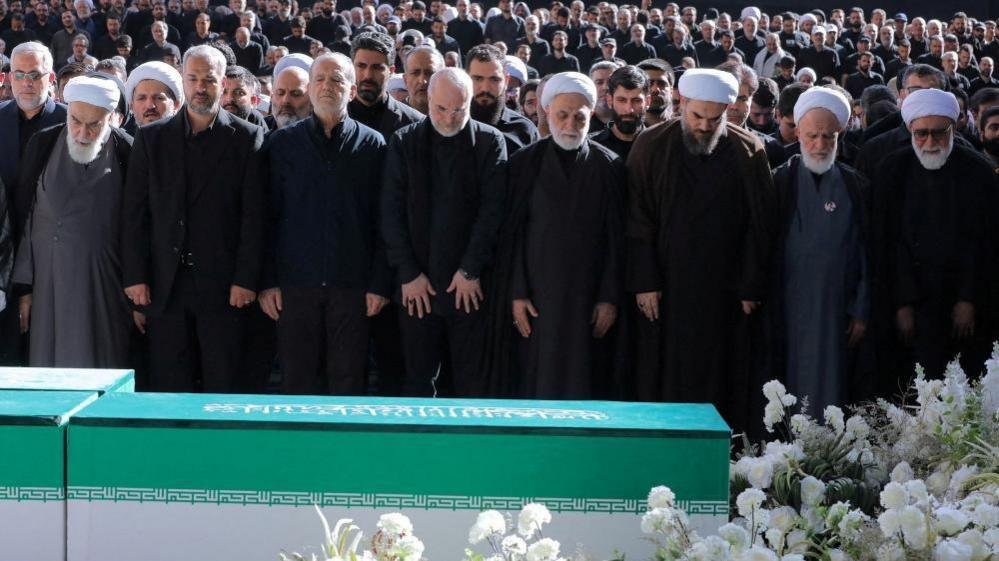
Iran’s Supreme Leader, Mojtaba Khamenei, was absent from the funeral of his father, former Supreme Leader Ali Khamenei, on Sunday, as top government officials and thousands of mourners gathered in Tehran to pay their final respects.
The funeral ceremony was attended by Ali Khamenei’s three other sons, Masoud, Mostafa and Meysam, alongside senior officials, including Iranian President Masoud Pezeshkian and Revolutionary Guards Chief, Ahmad Vahidi.
Mojtaba Khamenei’s absence has fuelled continued speculation over his health, following reports that he may have been wounded during the joint US-Israeli air strikes that killed his father.

He has not appeared publicly since assuming Iran’s highest office in March.
Official funeral ceremonies began on Friday and are expected to continue throughout the week across Iran and Iraq.
Iranian authorities estimate that between 12 million and 20 million people will participate in what officials have described as the “funeral of the century.”
Ali Khamenei’s body is lying in state at Tehran’s Grand Mosalla religious complex, where prominent Shia cleric Jafar Sobhani led funeral prayers attended by senior political, military and religious leaders.
Sunday was declared a public holiday in Iran to allow citizens to participate in the mourning ceremonies.
The late leader’s coffin is scheduled to be taken through Tehran in a massive procession before continuing to the holy city of Qom, then to key Shia religious sites in Iraq, ahead of his burial in his hometown of Mashhad later this week.
Security has been significantly tightened amid concerns that Israel could target Iran’s new leadership during the funeral period.
The ceremonies are taking place as a fragile ceasefire between Iran and Israel remains in place while negotiations over a permanent peace agreement continue.
Meanwhile, US President Donald Trump said peace negotiations had been paused during the funeral events, adding that although many of Iran’s senior leaders were gathered in one place, Washington would not target them because they remained essential to ongoing diplomatic efforts.
Read also:
- U.S. Military buildup, Iran supreme leader Vanishes, as protests that could topple regime rages
- US Launches Probe Against Iran’s Supreme Leader Over Alleged Money Laundering, Corruption
- New Iranian Supreme Leader Khamenei Reportedly injured in Airstrike, raises concerns over leadership stability
Large crowds packed Tehran’s streets, with many mourners chanting anti-American and anti-Israeli slogans. Some carried banners calling for retaliation against the United States and Israel, while speakers at the ceremony vowed revenge over the death of the former supreme leader.
Health officials said thousands of mourners had received medical attention due to the large crowds and soaring temperatures, although no fatalities had been reported.
Ali Khamenei, who ruled Iran from 1989 until his death, oversaw decades of confrontation with the West and maintained strong support for armed groups across the Middle East, including Hamas, Hezbollah and the Houthis, shaping Iran’s regional influence throughout his leadership.