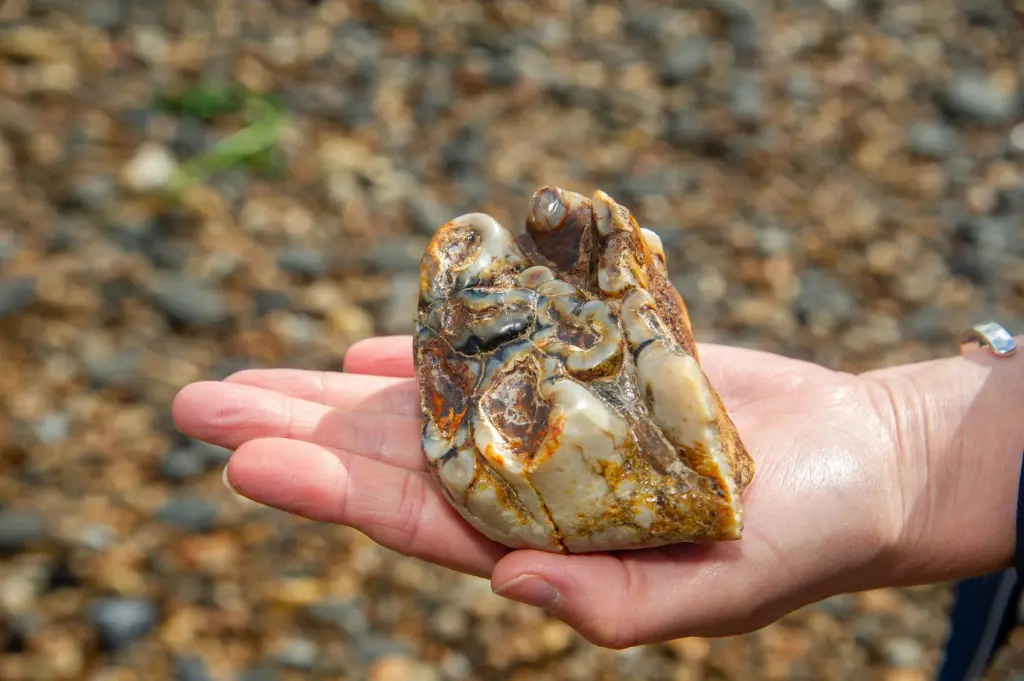
An 11-year-old boy has made a remarkable prehistoric discovery after finding the fossilised tooth of an ancient elephant relative dating back about 1.8 million years on a beach in eastern England.
Charlie Orchard-Lisle uncovered the unusual object, while walking with his family along East Lane Beach in Bawdsey, a coastal village near Ipswich in Suffolk.

Key Highlights:
- An 11-year-old boy found a 1.8-million-year-old elephant tooth on an English beach.
- Experts identified it as a molar from the extinct Anancus arvernensis.
- The fossil was discovered at East Lane Beach.
- Experts believe coastal erosion exposed and washed the fossil ashore.
- The find highlights the rich fossil history of England’s coastline.
The fossil, found near the shoreline, was later identified by experts as an upper left molar belonging to Anancus arvernensis, an extinct elephant species closely related to modern elephants, including the African bush elephant.
The tooth measures approximately four inches (10 centimetres) wide.
Charlie’s mother, Eleanor Orchard-Lisle, said the discovery was made just minutes after her son had been talking about his love for elephants.
“About 10 minutes before, Charlie was saying how much he loves elephants,” she recalled.
Read Also:
- Two Women arrested as community rescues abducted 6-month-old baby in Rivers State
- New INC President pushes for creation of Toru-Ebe, Oil Rivers States to address Ijaw marginalisation
- Suspected Rapist outsmart Nigerian Police, escapes from detention in Rivers State
“We saw this object by the waves, and it immediately caught our attention. It felt different from the surrounding rocks.”
The family believes the fossil may have been washed out from nearby Red Crag cliffs, a geological formation along England’s east coast renowned for preserving ancient marine and terrestrial fossils.
Coastal erosion is thought to have exposed the specimen before it was carried onto the beach.
“It is quite incredible. I can’t believe you can find something that existed 1.8 million years ago just lying on the beach,” Eleanor said.
The discovery adds to a growing list of remarkable archaeological finds made by children in recent months.
Earlier this year, schoolchildren in Norway uncovered a rare Viking-era sword, while an eight-year-old boy in Israel found a 1,700-year-old fragment of a Roman statuette during a family outing in the Negev Desert.
Experts say such discoveries highlight the scientific importance of fossil-rich coastal areas, where erosion can reveal remains of long-extinct animals that once roamed Europe millions of years ago.