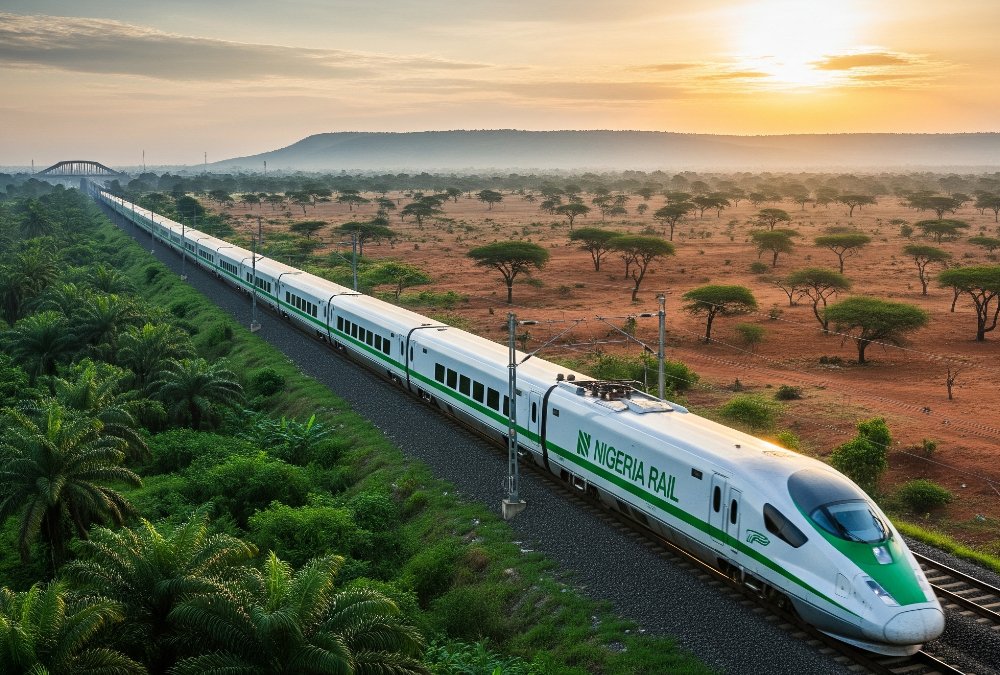
Nigeria is pursuing one of its most ambitious infrastructure initiatives in decades: a proposed $60 billion high-speed rail network spanning up to 4,000 kilometers. This project aims to connect major economic hubs and transform transportation, trade, and regional integration. While it has generated significant excitement, it remains in the planning and review phase as of mid-2026, with no construction underway yet.
Background and Project Overview
The high-speed rail proposal builds on years of discussions about modernizing Nigeria’s aging rail network, which has historically relied on narrow-gauge lines in poor condition. The new project envisions a modern, electrified (or gas-powered) high-speed system designed for speeds potentially reaching 200–350 km/h, far surpassing existing standard-gauge lines like the Lagos-Ibadan route.

Key promoters include:
De-Sadel Nigeria Limited (an Abuja-based firm) leading the consortium.
China Liancai Petroleum Investment Holdings Limited as the primary technical and financial partner.
Funding primarily linked to the Asian Infrastructure Investment Bank (AIIB) or related Chinese/Asian sources, with Nigeria’s natural gas reserves powering the system.
The overall vision is a Public-Private Partnership (PPP) that could eventually total around $200 billion for the full network connecting all 36 states and the FCT, positioning Nigeria with one of the largest high-speed rail systems globally after China.
Project Details
Total Network: Up to 4,000 km of high-speed rail.
First Phase: Approximately 1,600–1,700 km, focusing on key corridors:
Lagos – Abuja – Kano.
Abuja – Port Harcourt.
Cost: $60 billion total announced, with the first phase at about $55 billion.
Timeline (Proposed): First phase construction targeted for 36 months, with sectional openings (e.g., Lagos to intermediate points) before full completion. Some reports from 2025 mentioned possible groundbreaking in late 2026 and initial sections by 2027–2028.
Power Source: Primarily natural gas-fired electricity, leveraging Nigeria’s vast reserves (over 200 trillion cubic feet proven). This aligns with gas-to-power initiatives and reduces reliance on the national grid.
Phasing: Plans include western, central, and other corridors in subsequent phases, with east-west links and extensions to more states.
The project would drastically cut travel times (e.g., Lagos to Abuja in a few hours instead of a whole day by road) and support freight, industrial parks, job creation, tourism, and national unity.
Latest Updates
In August 2025, the consortium formally presented proof of funds for $60 billion to the Secretary to the Government of the Federation (SGF), Senator George Akume. This followed approval of the outline business case by the Infrastructure Concession Regulatory Commission (ICRC). Government officials, including Ministers of Transportation and Petroleum Resources (Gas), expressed strong support, highlighting alignment with President Bola Tinubu’s infrastructure and economic agenda.
Nearly 90% of preliminary approvals were secured at that time.
A technical review committee was established in early 2026 to assess feasibility, credibility, and details of the (expanded) proposal.
As of mid-2026, no groundbreaking or major construction has started. The project is still undergoing reviews, environmental clearances, community consultations, and final validations. Skepticism persists due to Nigeria’s history of ambitious but delayed projects, security concerns along routes, power reliability questions, and the massive scale.
Potential Benefits and Challenges
Benefits:
Massive job creation (direct and indirect, potentially millions).
Boost to trade, logistics, and industrialization.
Reduced road congestion and accidents.
Cleaner energy use via gas.
Enhanced connectivity across economic and political centers.
Challenges:
Huge financing and execution risks.
Security in parts of the country.
Technical viability (power supply, maintenance).
Land acquisition and environmental impacts.
Past rail projects (e.g., Lagos-Kano standard gauge) have faced funding and delay issues.
Read also:
- Senate launches probe into Railway projects amid frequent derailments
- Chinese bank approves $255m loan for Kano-Kaduna railway project
- Dafinone launches Egbo Uhurie Railway Station project
This high-speed proposal is separate from ongoing standard-gauge projects (e.g., Lagos-Kano segments built with Chinese involvement). Success here could complement and elevate Nigeria’s entire rail system.
The $60 billion high-speed rail project represents a bold vision for Nigeria’s future under the current administration. While momentum built in 2025 with funding proof and approvals, progress in 2026 has focused on detailed reviews. Nigerians and investors will watch closely for the next milestones—full business case approval, environmental nods, and actual groundbreaking.If realized, it could mark a historic leap in African infrastructure. For now, it remains a high-stakes proposal whose delivery will test Nigeria’s ability to execute mega-projects effectively.