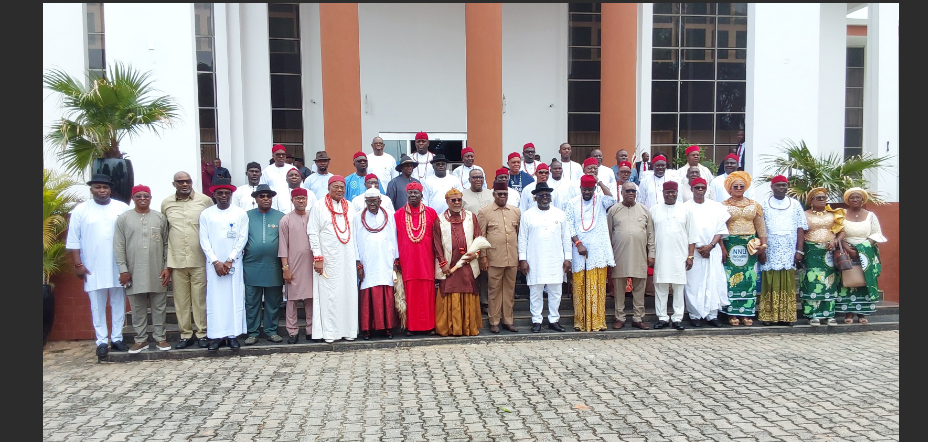
Leaders of the Ndokwa Nation, under the aegis of the Ndokwa Neku Union (NNU), have called on Delta State Governor, Sheriff Oborevwori, to order a review of the law establishing the Delta State Oil Producing Areas Development Commission (DESOPADEC), improve electricity supply in the area, establish a tertiary institution, and accelerate critical infrastructure projects across Ndokwa communities.
Key Highlights:

Presenting the position of the Ndokwa people, Asugwuni described the review of the DESOPADEC law as a matter of fairness and justice for oil-producing communities, arguing that the legislation, enacted in 2005, no longer reflects the realities of the contemporary oil and gas industry.
According to him, the law was formulated at a time when oil operations in the area were limited to a few operators, whereas several indigenous and multinational companies now operate across Ndokwa land, significantly changing the production landscape.
Read Also:
- Tenure Extension: NUJ demands accountability from DESOPADEC
- DESOPADEC takes drug/substance abuse campaign to Oproza, Patani
- Delta Governor Suspends DESOPADEC Commissioner, Dr. Charles Olise
He noted that a review of the law would ensure that host communities derive equitable benefits from oil production and align the legal framework with current industry realities.
The NNU president-general also highlighted the persistent electricity challenges facing many Ndokwa communities, stressing that improved power supply would stimulate investment, create jobs and unlock economic opportunities in the area.
He appealed to the governor to support the provision of critical power infrastructure, including step-down facilities and other interventions capable of improving electricity distribution and access.
Asugwuni further urged the state government to consider the establishment of a tertiary institution in Ndokwa Nation, arguing that the area remained underserved despite its contributions to the state’s economy.
He said such an institution would create employment opportunities, boost educational development and stimulate economic growth.
On infrastructure, he commended the governor for projects already executed in parts of Ndokwa land but appealed for accelerated attention to strategic road projects linking several communities, particularly those that remain isolated due to poor road networks.
Responding, Governor Oborevwori assured the delegation that his administration remains committed to addressing the developmental needs of the Ndokwa Nation and other parts of the state through equitable distribution of projects and resources.
The governor acknowledged the concerns raised on electricity supply, describing power as a major challenge not only in Ndokwa but across the country.
He disclosed that the Commissioner for Energy, Mr. Sunday Tatabuzogwu, alongside other stakeholders in the sector, had been actively exploring solutions aimed at improving electricity supply across Delta State.
He said the state government had taken note of the requests concerning power infrastructure and would continue to pursue practical measures to address them.
On the call for a review of the DESOPADEC law and other policy matters, Governor Oborevwori stressed that government would continue to operate within established legal and administrative procedures, noting that similar requests were being made by different ethnic nationalities and interest groups across the state.
The governor also responded to the demand for a university, noting that while government appreciates the aspirations of the Ndokwa people, establishing a new state university requires substantial financial commitment and careful planning.
He observed that Delta State already has several tertiary institutions and suggested that strengthening existing institutions, creating satellite campuses and improving educational infrastructure could offer practical alternatives to establishing entirely new universities.
Governor Oborevwori reiterated his administration’s commitment to infrastructural development, stating that significant projects had already been executed in Ndokwa land, with additional interventions being considered in subsequent budgets.
According to him, several requests made during previous visits to the area had already been addressed, while others were being implemented in phases.
The governor said his administration’s focus remains on delivering tangible projects rather than seeking publicity, citing completed road projects in Ndokwa West and ongoing infrastructure developments across the state as evidence of government’s commitment to development.
He commended the unity displayed by the Ndokwa delegation, noting the presence of traditional rulers, women, youths and community leaders, which he described as a demonstration of collective commitment to the progress of the area.
Governor Oborevwori assured the delegation that his administration would continue to serve all parts of Delta State fairly, maintaining that every ethnic nationality and community deserved equal access to development and government attention.