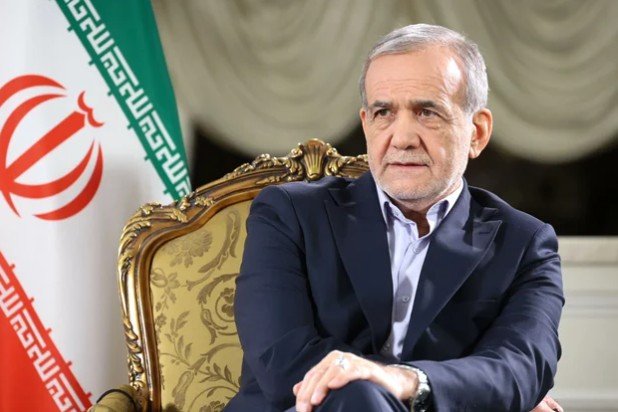
Iranian President Masoud Pezeshkian has reportedly submitted his resignation, citing the growing influence of the country’s powerful military establishment and his exclusion from key decision-making processes.
Key Highlights:
- Iran’s President Masoud Pezeshkian is reportedly said to have submitted a resignation letter, though it is not confirmed.
- He allegedly cited interference from the Islamic Revolutionary Guard Corps and being excluded from governance.
- The report claims his administration has been unable to fully carry out its constitutional duties.
- The resignation was reportedly sent to Supreme Leader Ali Khamenei for consideration.
- If true, it could indicate major political tension within Iran.
According to Iran International, a source familiar with the matter disclosed that Pezeshkian sent an official resignation letter on Sunday, to the office of Iran’s supreme leader, alleging that his administration had effectively been sidelined from major state affairs.

The report said the president argued that hardline factions within the Islamic Revolutionary Guard Corps (IRGC) had assumed control over critical aspects of governance, leaving his government unable to perform its constitutional responsibilities.
Pezeshkian reportedly stated that under the current circumstances, he could no longer effectively govern or fulfill his legal duties, prompting his request to step down immediately.
The development, if confirmed, would mark one of the most significant political crises in Iran in recent years and could signal a deepening rift within the country’s leadership structure.
Read also:
- Trump says he ‘wasn’t worried’ during shooting at Correspondents’ Dinner
- Rubio says ‘solid’ Iran deal likely on Monday
- U.S targets Iran-linked militia leader with $10m reward
It remains unclear whether Iran’s Supreme Leader, Mojtaba Khamenei, will accept the resignation.
However, the contents of the reported letter suggest growing tensions between the civilian government and the country’s military-security institutions.
The report comes amid months of speculation about increasing IRGC influence over state affairs.
Iran International previously reported that the military organization had gradually curtailed presidential powers and expanded its control over key government functions.
Sources cited by the outlet claimed the situation had left Pezeshkian’s administration in a state of political and executive paralysis, hindering diplomatic initiatives and delaying planned cabinet reforms.
The reported resignation also follows broader political tensions within Iran’s ruling establishment, including recent controversies surrounding comments by hardline lawmaker, Hamid Rasaei that were interpreted by critics as indirect criticism of Mojtaba Khamenei’s leadership.
The Iranian government has not publicly commented on the resignation report as of the time of filing this report.
If accepted, Pezeshkian’s departure could trigger a major political realignment in the Islamic Republic at a time when the country is also navigating sensitive negotiations with the United States and the aftermath of recent regional conflicts.