Fresh strikes on Iran ordered by United States President Donald Trump have intensified global security concerns as conflicts across the Middle East and Eastern Europe continue to deepen, with Israel expanding military operations in Lebanon and Russia threatening renewed attacks on Kyiv.
Key Highlights:
•US launches new strikes on Iran targeting missile sites and naval operations
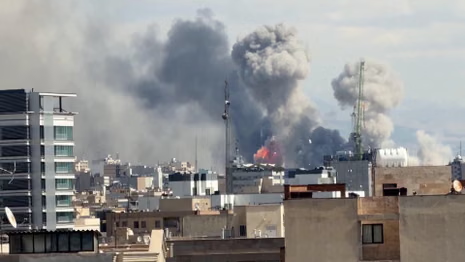
•Explosions reported near Bandar Abbas along the Strait of Hormuz
•Iran says ceasefire agreement with the US is “not imminent”
•Israeli Prime Minister Benjamin Netanyahu vows intensified strikes on Hezbollah in Lebanon
•Russia threatens fresh large-scale attacks on Kyiv amid ongoing Ukraine war
•Rising tensions trigger fears of wider regional and global instability
•Oil market volatility and geopolitical uncertainty continue to grow
The US military confirmed that fresh operations targeted Iranian missile facilities and vessels allegedly attempting to deploy naval mines in southern Iran.

According to US Central Command, the strikes were carried out in “self-defense” to protect American forces and allied interests in the region.
The attacks reportedly focused on areas surrounding Bandar Abbas, a strategic Iranian port city located along the Strait of Hormuz and home to key Iranian naval installations.
Local Iranian officials confirmed explosions in the area, although Tehran had not officially responded to the latest American military action as of press time.
Despite ongoing diplomatic discussions between Washington and Tehran, Iranian Foreign Ministry spokesman Esmail Baqai said a final agreement to end hostilities “is not imminent.”
Reports indicate negotiations currently revolve around a proposed 60-day ceasefire extension, reopening of the Strait of Hormuz, and renewed talks over Iran’s nuclear programme.
President Trump also suggested that Iran’s enriched uranium stockpile could either be surrendered to the United States or destroyed under a monitored arrangement involving Iranian authorities.
The current crisis escalated following joint US and Israeli strikes on Iran earlier this year, which triggered retaliatory attacks on Israel and several Gulf states allied to Washington.
The growing instability has contributed to rising global oil prices and renewed fears over energy supply disruptions.
Meanwhile, Israeli Prime Minister Netanyahu announced plans to intensify military operations against Hezbollah in Lebanon.
The Israel Defense Forces launched additional strikes across the Bekaa Valley and surrounding areas, accusing Hezbollah of continued attacks despite an earlier ceasefire extension.
Netanyahu declared that Israel was “at war with Hezbollah” and vowed to deliver what he described as a “crushing blow” against the group.
The renewed offensive has raised fears that hostilities could spread further into Beirut and destabilise the wider region.
Reports indicate that hundreds of Hezbollah fighters and Lebanese civilians have been killed since the escalation resumed, with thousands displaced from their homes.
Lebanon’s government has continued to push for a ceasefire and the disarmament of Hezbollah, while Israel insists military action remains necessary for national security.
In Eastern Europe, Vladimir Putin warned of fresh “systematic strikes” on Kyiv following one of Russia’s largest aerial attacks on the Ukrainian capital since the war began.
Moscow said future strikes could target command centres, drone production facilities, and strategic infrastructure.
Read also:
- Trump says he ‘wasn’t worried’ during shooting at Correspondents’ Dinner
- Rubio says ‘solid’ Iran deal likely on Monday
- U.S targets Iran-linked militia leader with $10m reward
Ukrainian authorities condemned the threats, describing them as “blackmail,” while urging Western allies to intensify pressure on Russia.
Recent attacks on Kyiv reportedly killed several civilians and damaged residential buildings, markets, and public infrastructure.
Analysts warn that the convergence of the conflicts involving the US, Iran, Israel, Lebanon, and Russia reflects a dangerous period of rising geopolitical instability that could have significant economic and humanitarian consequences worldwide.