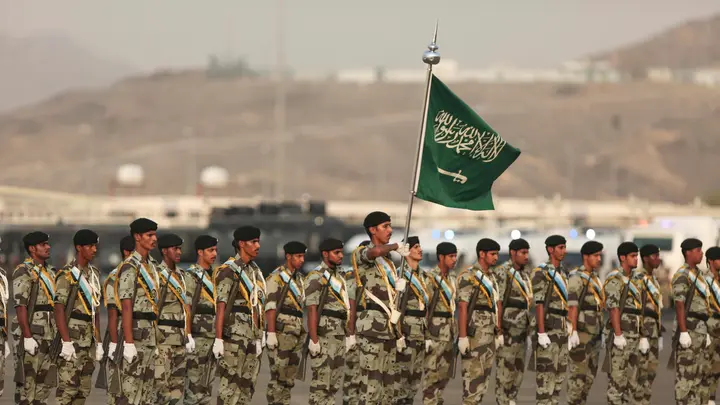
Saudi Arabia has launched an extensive security operation ahead of the 2026 Hajj pilgrimage, staging a massive military parade in the holy city of Mecca as authorities intensify preparations for millions of worshippers expected from across the world.
The large-scale display, described by officials on Friday, as a “show of force,” featured multiple branches of the kingdom’s security architecture, including the Special Forces for Hajj and Umrah Security, the National Guard, civil defense units, emergency response teams, and other military formations tasked with safeguarding pilgrims during Islam’s annual pilgrimage.

Key Highlights:
- Saudi Arabia held a military parade in Mecca to demonstrate readiness for the Hajj 2026.
- Security forces and emergency agencies carried out crowd-control and evacuation drills.
- Authorities showed preparedness measures for managing millions of pilgrims safely.
- Strict enforcement rules will restrict Mecca access to only valid Hajj permit holders.
- AI technology, drones, and surveillance systems will be used to enhance safety and monitoring.
The exercise is aimed at demonstrating operational readiness, discipline, and coordination among security agencies responsible for managing one of the world’s largest religious gatherings.
During the parade, security personnel showcased rapid-response drills, crowd-control tactics, emergency evacuation procedures, and surveillance operations designed to prevent disruptions during the pilgrimage season.
Saudi authorities said the exercises were part of broader efforts to ensure a safe, organized, and secure Hajj experience for all pilgrims.
The officials also announced stricter enforcement measures for entry into Mecca, warning that only pilgrims with valid Hajj permits would be allowed access to the holy sites.
Related Articles:
- Why Ramadan month is special for Muslims
- Gov Otti calls for peace, tolerance as Muslims celebrates Eid-el-Fitr
- Eid-El-Maulud: Oborevwori hails Muslims, urges prayers for Nigeria’s progress
Security checkpoints have been established on major roads leading into Mecca, with officers conducting intensive inspections of vehicles and travelers.
The authorities stressed that violators attempting to perform Hajj without authorization could face severe penalties, including heavy fines, deportation, and possible imprisonment.
The kingdom has repeatedly emphasized that permit regulations are essential for controlling overcrowding and ensuring public safety, especially as the number of pilgrims continues to grow annually.
In addition to the physical deployment of personnel, Saudi Arabia is also relying heavily on advanced technology to strengthen monitoring and coordination efforts during the pilgrimage.
The Unified Security Operations Center has reportedly activated sophisticated surveillance systems across Mecca and surrounding holy sites, including artificial intelligence-powered monitoring platforms, drones for aerial observation, and expanded networks of smart cameras capable of tracking crowd movement in real time.
Officials said the integration of AI and drone technology would help authorities detect unusual activity quickly, improve emergency response times, and manage crowd flow more efficiently during peak pilgrimage periods.
Medical teams, emergency responders, and logistical support units have also been placed on high alert as part of the kingdom’s comprehensive Hajj preparedness strategy.
The annual Hajj pilgrimage draws millions of Muslims from around the world to Saudi Arabia and remains one of the largest and most complex crowd-management operations globally.
The 2026 Hajj is expected to witness one of the most technologically monitored pilgrimages in the kingdom’s history as Saudi Arabia combines traditional security measures with modern surveillance and crowd-management tools.