
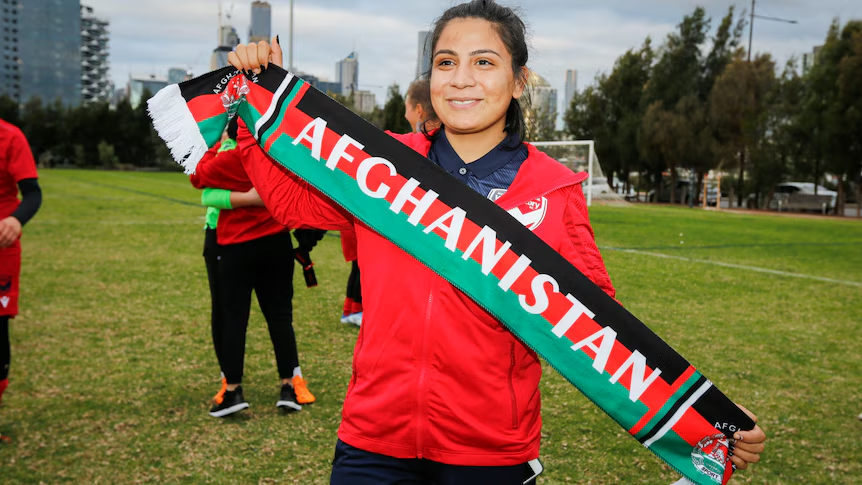
Afghanistan’s women’s national team is set to make a long-awaited return to international football after FIFA approved new measures allowing their participation under exceptional circumstances.
The decision follows years of uncertainty for the team, which last played a competitive match in 2018.

The situation worsened after the Taliban regained control of Afghanistan in 2021, leading to strict limitations on women’s rights, including a ban on women’s sports.
Many players were forced into exile, scattering across Europe, Australia, the United States, and the Middle East.
Under previous FIFA rules, teams could only compete if officially recognised by their national federation, in this case, the Afghanistan Football Federation.
However, a recent amendment approved at a FIFA Council meeting in Vancouver now allows the global body to register teams in exceptional cases, ensuring athletes are not sidelined due to circumstances beyond their control.
Former captain Khalida Popal described the move as a powerful step forward, calling the team a “symbol of resilience.”
Read Also:
- US lawmakers, FIFA clash over transport costs ahead of 2026 World Cup
- England Superfan plans to sell House to fund FIFA World Cup 2026 dream
- FIFA fines Israel FA over racism, orders anti-discrimination measures in Stadium
She noted that while challenges remain, especially for women still inside Afghanistan, the team hopes to inspire and represent those who cannot currently play.
The breakthrough builds on the creation of Afghan Women United, a refugee team supported by FIFA since 2025.
The side has already competed in friendly matches, recording a notable victory over Libya during last year’s FIFA Women’s series.
While Afghanistan will not feature in qualification for the 2027 FIFA Women’s World Cup, the team is expected to compete in future international fixtures, including potential qualification for the 2028 Olympic Games.
FIFA president Gianni Infantino praised the initiative, highlighting it as part of a broader effort to ensure inclusivity in global football and provide displaced athletes with opportunities to continue their careers.
With regional training camps already underway in England and Australia, and a full camp planned in New Zealand, Afghanistan’s women footballers are now preparing for a return that carries not just sporting significance but a powerful message of hope and determination.