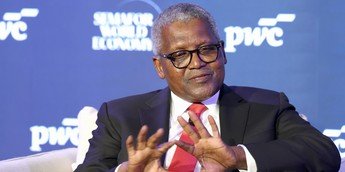
Africa’s richest man, Aliko Dangote, has seen his net worth surge to $33.2 billion, marking a $3.21 billion increase in 2026 and reinforcing his dominance among the continent’s wealthiest individuals.
According to the Bloomberg Billionaires Index, the sharp rise reflects strong performance across Dangote’s industrial empire, particularly in energy. His gains place him among Africa’s top-performing billionaires this year, alongside peers like Natie Kirsh and Abdulsamad Rabiu.

A major driver of Dangote’s wealth growth is the impact of the Dangote Petroleum Refinery, which is transforming Nigeria’s energy landscape.
For the first time in decades, Nigeria has emerged as a net exporter of refined petroleum products, signalling a significant shift from its long-standing dependence on fuel imports.
Data from energy analytics firm Kpler shows the country exported about 44,000 barrels of petrol per day in March 2026, slightly exceeding imports.
Read Also:
- Dangote’s Refinery assures it has enough stock to meet demand
- Shettima seeks the safeguarding of Dangote’s investments by Nigerians
- NUPENG, Dangote’s Trucking Union clash over Tanker Drivers as fresh crisis rocks oil sector
The refinery has also expanded Nigeria’s footprint in regional markets, shipping refined products to countries including Côte d’Ivoire, Cameroon, Ghana, Togo, and Tanzania.
Despite the progress, challenges remain in Nigeria’s oil supply chain. Between 2024 and early 2026, the country imported an estimated 61.7 million barrels of crude oil from the United States, valued at roughly $4.9 billion partly to meet refining needs.
This highlights ongoing constraints in domestic crude production, even as refining capacity improves.
Dangote is now deepening investments in petrochemicals to strengthen Nigeria’s industrial base.
The refinery is exploring collaboration with Honeywell International Inc. to produce 400,000 metric tons of linear alkylbenzene annually, a key ingredient in detergent manufacturing.
The move is part of a proposed $11.5 billion expansion plan aimed at reducing import dependence and boosting local manufacturing.
Dangote’s rising fortune reflects more than market valuation; it underscores the scale of his long-term industrial strategy.
From reshaping Nigeria’s fuel trade balance to building capacity in petrochemicals, his investments are playing a central role in redefining the country’s economic trajectory.
As Nigeria strengthens its position in regional energy markets, Dangote’s refinery-led expansion continues to drive both national transformation and his rapid climb in global wealth rankings.