
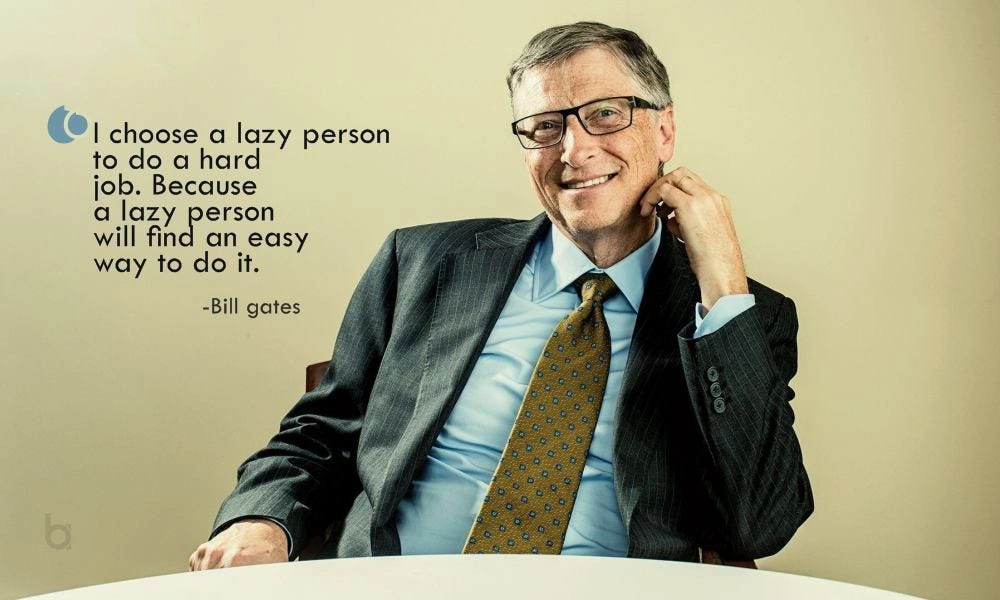
Tech entrepreneur Bill Gates has stirred discussion after revealing why he hires so-called “lazy” individuals for challenging tasks, stating: “I chose a lazy person to do a hard job, because a lazy person will find an easy way to do it.”
At first glance, the statement may seem counterintuitive, but Gates emphasizes that efficiency and ingenuity drive the approach. According to him, individuals motivated to avoid unnecessary effort often discover smarter, faster ways to complete tasks, fueling innovation and minimizing wasted energy.

Business experts support Gates’ perspective. Management consultant Dr Angela Okeke told reporters on April 8, 2026, that “Innovation often comes from the drive to simplify. People who look for shortcuts sometimes invent solutions that others wouldn’t even consider.”
Read also:
- AE- FUNAI launches institute for future skills, innovation
- Dangote Sugar Refinery issues final warning to staff over chewing Sugar Cane at Adamawa Plant
- U.S. orders Embassy evacuation in Nigeria over security concerns
The principle is increasingly applied in corporate environments focused on productivity and cost-efficiency. Organizations prioritizing smart work over sheer effort often report faster results, higher employee satisfaction, and enhanced problem-solving capabilities.
Critics, however, caution against interpreting Gates’ remarks as promoting idleness. The emphasis, he insists, is on creativity and ingenuity rather than true laziness.
In a business world where efficiency and innovation are highly valued, Gates’ comments challenge conventional ideas of hard work, suggesting that thinking like a “lazy” person can sometimes be the most effective strategy.