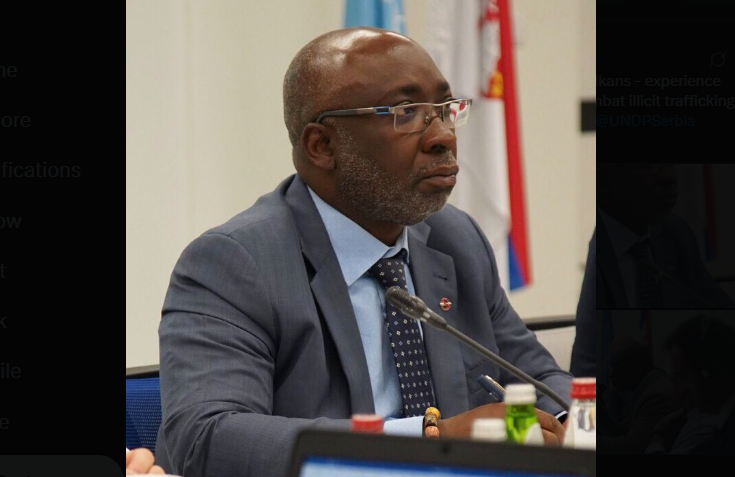
In an exclusive interview with The Trumpet Newspaper, our Sub-Editor Blessing Oziwo sits down with Mr Joseph Ahoba, immediate past Head of the Small Arms Division at the Economic Community of West African States (ECOWAS), to reveal an insider’s view of West Africa’s ongoing struggle against the proliferation of small arms and light weapons (SALW). From curbing artisanal weapons production to reinforcing regional regulatory frameworks, Ahoba shares insights on policy strategies, cross-border challenges, and the lasting legacy of his tenure in strengthening security governance across the region.

To what extent has your division gone in preventing or reducing local craft production of SALW?
During my tenure as Head of the Small Arms Division, the Division made significant progress in addressing the challenge of locally manufactured small arms and light weapons. One of our most impactful interventions was the conduct of a comprehensive regional study on artisanal and craft production of arms across ECOWAS Member States.
Building on the findings of this study, we developed, finalized, and validated a regional guideline on the regulation of artisanal arms production. This instrument provides concrete measures for Member States, including licensing frameworks, registration of craftsmen, monitoring mechanisms, and integration of local manufacturers into formal regulatory systems.
The objective is not only to control illicit production but also to transform the sector into a regulated and accountable component of national security governance. This represents a major step toward reducing the proliferation of illicit SALW in the region.
What was your biggest challenge in fighting arms proliferation?
The most significant challenge in combating arms proliferation in the ECOWAS region remains the porosity of borders. Many of our borders are vast, difficult to monitor, and in some cases not adequately manned or equipped due to their contiguous nature.
Read Also:
- Edun meets IMF director in Abuja, pushes for stronger ECOWAS economic coordination
- SERAP sues Tinubu at ECOWAS Court over alleged “mass phone tapping” regulations
- Breaking: ECOWAS declares state of emergency in West Africa
This situation creates enabling conditions for the illicit trafficking of arms and ammunition across countries, often linked to transnational organized crime and terrorist networks.
Addressing this challenge requires not only strengthening border management capacity, but also enhancing cross-border cooperation, intelligence sharing, and regional coordination mechanisms among Member States.
What was your most significant achievement as Head of the Small Arms Division?
It is difficult to single out one achievement, given the breadth of progress made during my tenure. However, two areas stand out.
First is the development, finalization, and validation of key regional frameworks and regulatory instruments, including:
The ECOWAS Model Guide for the Implementation of the ECOWAS Convention on SALW and the Arms Trade Treaty (ATT)
The Guideline on the Regulation of Artisanal Arms Production
The Guideline on Civilian Possession of Arms
The Regional Strategy on Countering Improvised Explosive Devices (IEDs)
These frameworks have significantly strengthened the policy and regulatory architecture of arms control in the region.
Second, we invested heavily in capacity building, particularly through the establishment of a regional pool of expert instructors on Physical Security and Stockpile Management (PSSM). Today, ECOWAS Member States can rely on in-region expertise for training and support, reducing dependence on external partners and strengthening regional ownership.
What was your biggest challenge as Head of the Small Arms Division?
Beyond border challenges, one of the biggest institutional challenges was ensuring effective implementation of regional frameworks at the national level.
While ECOWAS has strong normative instruments, translating these into concrete actions across all Member States—given differences in capacity, resources, and political priorities—remains a complex task.
Another challenge was resource constraints, particularly in sustaining long-term interventions such as stockpile management, border control systems, and national coordination mechanisms.
Despite these challenges, we made steady progress through partnerships, advocacy, and capacity-building initiatives.
What are your regrets, or what would you have done differently?
If I were to reflect critically, I would say that I would have pushed even earlier and more aggressively for stronger integration of technology in arms control systems, particularly in areas such as weapons marking, tracing, and digital record-keeping.
Additionally, I would have sought to deepen private sector engagement and local industry regulation frameworks earlier, especially in addressing craft production and dual-use materials.
However, given the institutional and resource constraints, I believe we maximized available opportunities and laid a strong foundation for future progress.
What would you like to be remembered for?
I would like to be remembered for three key things:
1. Leadership & People-Centered Legacy:
I would like to be remembered as a leader who not only delivered results but also invested in people—someone who created an environment where staff could discover their potential, grow professionally, and take ownership of their work. For me, true leadership is about building individuals and institutions that will continue to thrive long after one’s tenure.
2. Institutional Impact & Sustainability:
I would like to be remembered for strengthening the institutional and regulatory architecture of arms control in the ECOWAS region—laying down frameworks, systems, and capacities that will endure and continue to guide Member States in addressing the proliferation of small arms and emerging security threats.
3. Regional Ownership & Capacity Building:
I would like to be remembered for promoting regional ownership—particularly in building local expertise in areas such as Physical Security and Stockpile Management. Moving the region from dependence on external support to self-sustaining capacity is, for me, one of the most meaningful contributions.