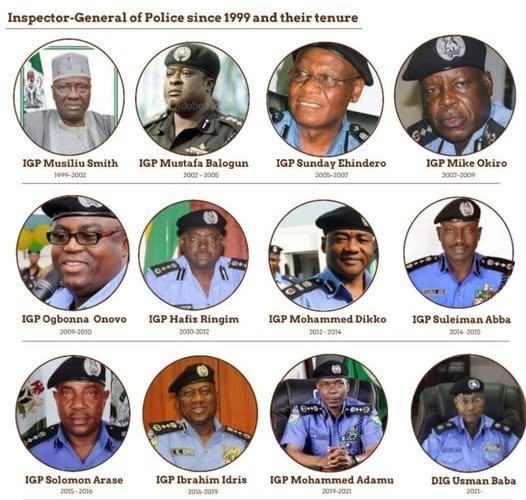
Since Nigeria’s return to democratic rule in 1999, the appointments into the office of the inspector-general of police (IGP) have followed a pattern that observers say mirrors the regional and political calculations of successive presidents.
An analysis of the appointments of the inspector general of police from the administration of former President Olusegun Obasanjo to the current government of President Bola Tinubu reveals a striking regional trend tied to each Presidency.
Under Obasanjo (1999–2007), all appointed IGPs hailed from the South-West: Musiliu Smith; Mustafa Balogun; and Sunday Ehindero.

The concentration of appointments within the president’s geopolitical zone drew quiet criticism at the time, though it was largely framed as administrative discretion.
During the administration of late Umaru Yar’Adua (2007–2010), the pendulum swung to the South-East: Mike Okiro, and Ogbonna Onovo.
Both appointments were seen as part of broader federal balancing efforts, although critics argued that the police leadership remained entangled in political calculations.
Under former President Goodluck Jonathan (2010–2015), the IGP position was dominated by officers from the North-West: Hafiz Ringim; Mohammed D. Abubakar; and Suleiman Abba.
Security challenges, including the Boko Haram insurgency, defined this period, and leadership changes at the top of the police were often linked to operational failures and political tensions.
Former President Muhammadu Buhari (2015–2023) appointed IGPs from multiple regions: Solomon Arase (South-South); Ibrahim Kpotun Idris (North-Central); Mohammed Abubakar Adamu (North-Central)
While Buhari’s appointments reflected a broader regional spread compared to previous administrations, critics argued that performance and security outcomes remained inconsistent, especially amid rising insecurity nationwide.
Under PresidentTinubu, the trend appears to have returned to the South-West.
Kayode Egbetokun was appointed IGP in 2023. Reports now indicate that Assistant Inspector-General (AIG) Tunji Disu, also from the South-West, is now the next Inspector-General.
The new development, would make it two consecutive IGPs from the same geopolitical zone under Tinubu’s Presidency.
Read also:
- IGP Egbetokun meets Committee on Petroleum Resources
- Tinubu removes Egbetokun, appoints Tunji Disu as successor
- CSO defends Egbetokun, condemns smear campaigns to force him out of office
While the 1999 Constitution does not mandate rotational appointments for the office of the IGP, the federal character principle encourages equitable distribution of public offices across regions.
Political analysts argue that the pattern of IGP appointments since 1999 raises questions about whether regional loyalty, political trust, or professional merit primarily drives selections.
With Nigeria facing persistent security crises—from banditry to insurgency and separatist agitations—the debate over competence versus regional balancing in security leadership is likely to intensify.
As another transition at the helm of the police force looms, attention will once again focus not just on who gets the job, but what that choice signals about power, politics, and national cohesion.