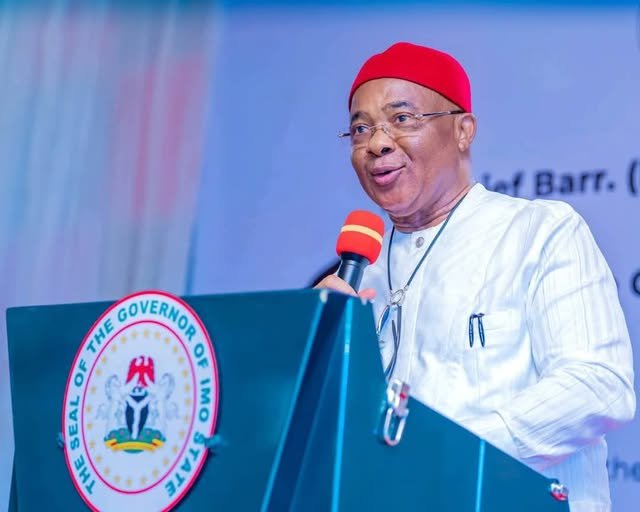
As Imo State approaches the end of the impactful second term of Governor Hope Uzodimma, the debate over zoning and equity has naturally resurfaced.
Speculation, anticipation and cautious optimism have since gripped citizens across the state.

The Imo Charter of Equity; an unwritten but widely acknowledged political understanding was designed to promote fairness, balance and inclusion among the three senatorial zones: Owerri, Orlu and Okigwe.
With Orlu having held power under Governor Uzodimma, the moral and political argument now rests between Owerri and Okigwe.
However, a compelling case can be made that 2028 presents a historic opportunity for Okigwe Zone.
1. The Principle of Equity, Fairness and Rotation
The strength of any plural society lies in its ability to balance power in a way that fosters belonging.
Okigwe Zone has, over time, played critical roles in the political and economic development of Imo State, yet its opportunity at the governorship level has remained limited.
Read Also:
- Ikarama communities decry Government, Oil Companies’ neglect
- “One day, a Woman will lead Nigeria as President” – Barrister Juliet I.I. Asekomeh
- Balancing Tinubu’s economic interest with political stability in Rivers
Zoning is not merely about politics; it is about justice, inclusion and stability.
Allowing Okigwe to produce the next governor would somewhat reinforce trust in the equity arrangement and strengthen unity across the state.
2. Competence and Capacity
Okigwe Zone is not short of experienced administrators, technocrats and political leaders with proven records in governance, public service and private enterprise.
The zone boasts individuals who understand both grassroots mobilization and institutional leadership.
For instance, in the nation’s capital, Abuja, prominent sons and daughters of Okigwe Zone can be found thriving and making remarkable strides across diverse sectors, contributing meaningfully to growth and development of their respective communities and society at large.
The question, therefore, is not whether Okigwe has capable hands, rather it is whether the state is ready to give the zone the opportunity to serve at the highest level.
3. Strengthening Statewide Unity
In multi-zonal political systems, inclusiveness reduces tension and uncertainty.
Granting Okigwe the governorship in 2028 would foster greater cooperation between zones, particularly if anchored on consultation and consensus-building with Owerri and Orlu.
Political inclusion builds stability. Stability builds development.
4. The Spiritual Dimension
Interestingly, leaders and stakeholders of Okigwe Zone recently gathered during the Lenten season to commit the 2028 aspiration into God’s hands.
The symbolic move reflects a desire for divine guidance and unity above just political ambition.
Most importantly, the Holy Scripture reminds us in Galatians 6:9, “Let us not grow weary in doing good, for in due season we shall reap, if we faint not.”
Perseverance and patience often precede fulfillment. For many in Okigwe, 2028 may represent that “due season.”
5. A Call for Constructive Dialogue
This is not an argument against Owerri Zone, nor a dismissal of its legitimate expectations.
Rather, it is a call for honest dialogue rooted in fairness and long-term stability.
The ultimate goal must remain the progress of Imo State above all; infrastructure, security, economic growth, youth empowerment and social development.
Whichever zone produces the next governor must prioritize competence and collective interest above sectional sentiment.
As the 2028 governorship election approaches, the conversation should not descend into rivalry, but rise into reasoned engagement.
If the Charter of Equity is to remain credible and meaningful, then Okigwe’s aspiration deserves serious consideration.
Evidently, history has consistently shown that patience, unity, and careful preparation are often rewarded.
Perhaps, that moment is drawing near for Okigwe Zone.