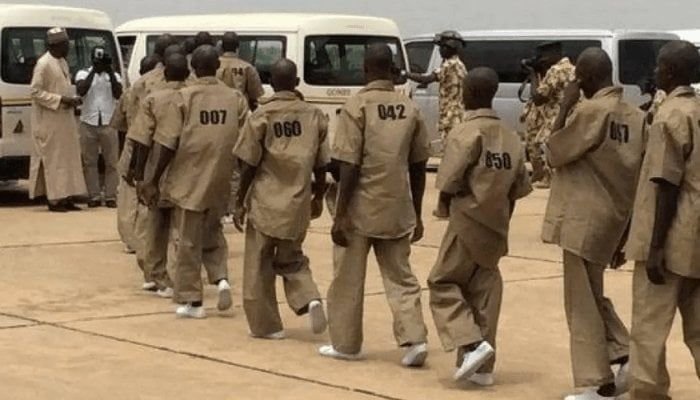
No fewer than 117 repentant terrorists have completed the Federal Government’s de-radicalisation, rehabilitation and reintegration (DRR) programme under Operation Safe Corridor in Borno State.
The development was disclosed on Thursday in a statement by the Director of Defence Information, Major General Samaila Uba. He said the Coordinator of Operation Safe Corridor (OPSC), Y. Ali, announced the graduation during a high-level stakeholders’ meeting convened by Defence Headquarters in collaboration with OPSC leadership at the Nigerian Army Resource Centre.

According to the statement, the meeting focused on finalising arrangements for transferring the rehabilitated individuals to relevant state and national authorities for reintegration into society.
Ali explained that the former combatants underwent the DRR process at the Mallam Sidi Camp, describing their graduation as a reflection of improved coordination between federal and state governments in reception, monitoring and community reintegration.
Read Also:
- Gov. Zulum flags off Ramadan palliatives for 300,000 households in Borno
- Boko Haram, ISWAP fighters storm Army Base in Borno, kill Soldiers, torch military assets
- Zulum commissions second chance school for vulnerable girls, disburses N1bn to SMEs in Borno
He commended the Chief of Defence Staff, Olufemi Oloyede, for providing strategic leadership and institutional support for the initiative. He noted that the programme aligns with the CDS’s philosophy of enhanced jointness, improved welfare and sound administration under a whole-of-government framework.
Ali stated that OPSC operates as a multi-agency humanitarian stabilisation programme backed by the 1999 Constitution and international humanitarian and human rights instruments, drawing personnel from 17 services, ministries, departments and agencies.
Since its establishment in 2016, he said the initiative has strengthened screening processes, refined ideological disengagement modules, improved psychosocial recovery systems and expanded inter-agency collaboration to ensure accountability and sustainable reintegration outcomes.
He also revealed that the programme has expanded to the North-West, where a DRR camp established in February last year marked a significant stabilisation milestone. OPSC is currently engaging with the Zamfara State Government to reposition the facility into a comprehensive victim healing, rehabilitation and reintegration centre, integrating psychosocial recovery, community reconciliation, livelihood support and structured monitoring.
Ali further disclosed that Benue State has formally requested the establishment of a DRR camp. Defence Headquarters has assessed proposed locations and advised that any approval must align with national standards on infrastructure, security and sustainability.
Outlining the objectives of the stakeholders’ meeting, he said discussions centred on clarifying the roles of state authorities and ministries, identifying structured resettlement support frameworks, agreeing on community sensitisation and camp visitation modalities, and ratifying graduation timelines.
Representing the Chief of Defence Staff, the Chief of Defence Operations at Defence Headquarters, Jamal Abdusalam, reaffirmed Nigeria’s commitment to a whole-of-government and whole-of-society approach to peacebuilding.
He described Operation Safe Corridor as a critical element of Nigeria’s security architecture, noting that while military operations create conditions for stability, structured rehabilitation and reintegration are essential to consolidating gains and preventing renewed violence.
The meeting attracted participants from federal ministries, the Office of the National Security Adviser, state governments, neighbouring countries—including Burkina Faso, Chad, Niger and Cameroon—as well as international partners such as Norway, the United Kingdom, the European Union, the Foreign, Commonwealth and Development Office, the International Committee of the Red Cross and the International Organization for Migration.