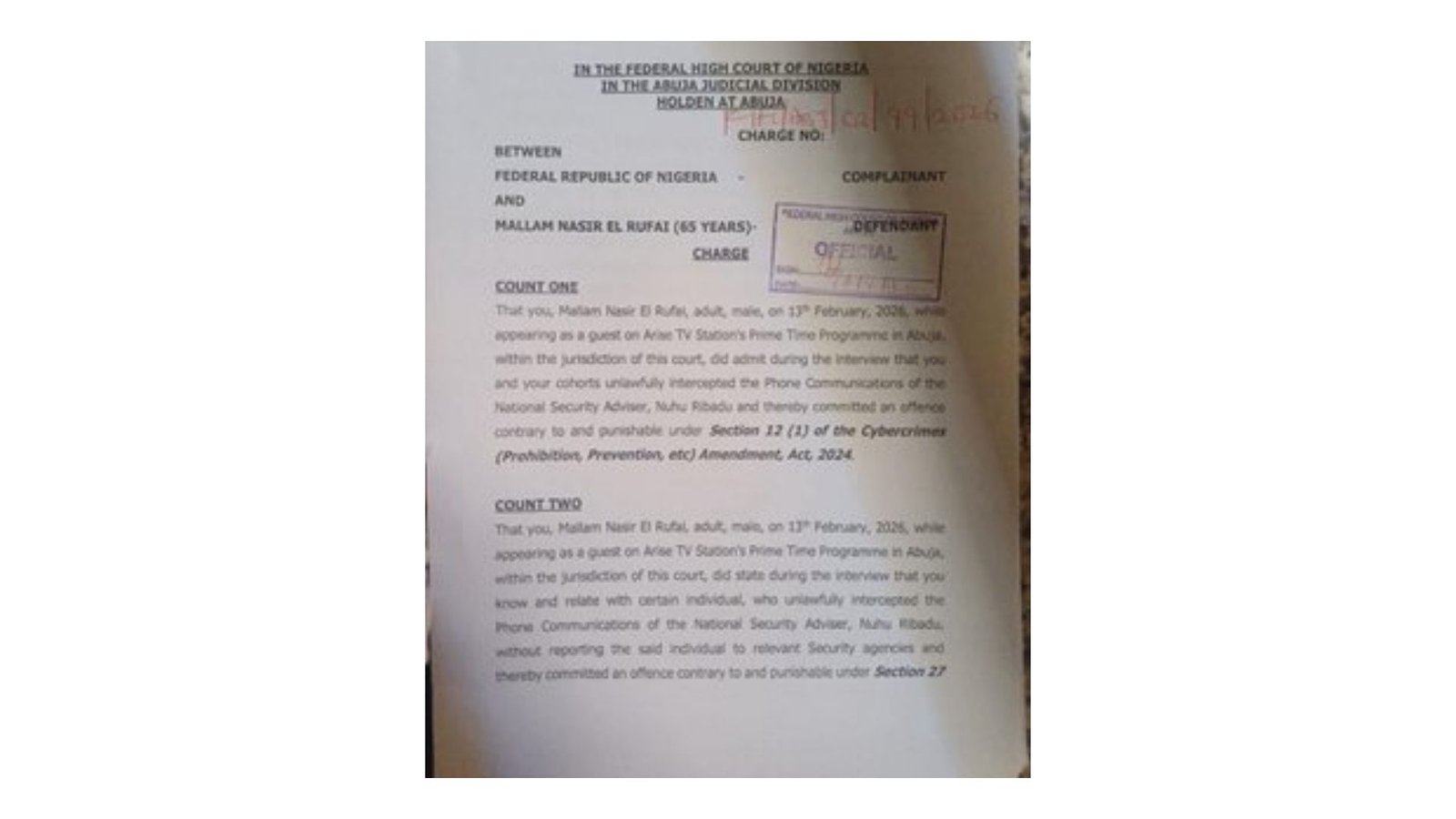
The Federal Government is set to arraign former Kaduna State governor, Nasir El-Rufai, before the Federal High Court in Abuja over allegations of unlawful interception of the phone communications of the National Security Adviser, Nuhu Ribadu.
The charge, marked FHC/CR/99/2026, was filed in the name of the Federal Republic of Nigeria, with El-Rufai, 65, listed as the sole defendant. The charge sheet is dated February 16, 2026.
According to court documents, the prosecution alleges that El-Rufai made incriminating admissions during a televised interview on February 13, 2026, while appearing on Arise TV’s Prime Time programme in Abuja.

Alleged Breach of Cybercrimes Act
 In Count One, the Federal Government alleges that El-Rufai admitted to unlawfully intercepting the phone communications of the National Security Adviser. The offence is said to contravene Section 12(1) of the Cybercrimes (Prohibition, Prevention, etc.) Amendment Act, 2024.
Read also:
- Presidency accuses El-Rufai of spreading false Thallium claims to distract from ₦432bn Kaduna corruption probe
- NSA demands evidence from El-Rufai over allegations of deadly chemical procurement
- Presidency orders probe into El-Rufai over alleged wire-tapping of NSA Ribadu
Count Two alleges that the former governor acknowledged knowing and associating with individuals who allegedly intercepted the NSA’s communications but failed to report them to relevant security agencies. Prosecutors say this constitutes an offence under Section 27(b) of the same Act.
Charge Under Nigerian Communications Act
Count Three further alleges that El-Rufai and others still at large used technical equipment or systems that compromised public safety and national security by unlawfully intercepting the NSA’s phone communications. The charge cites Section 131(2) of the Nigerian Communications Act, 2003.
The prosecution team, acting on behalf of the Department of State Services, includes Ernest O.M., Owan O.M., U.M. Bulla, C.S. Eze, and E.G. Orubor.
The matter is expected to test the application of Nigeria’s Cybercrimes Act and communications law in cases involving alleged unlawful surveillance and national security concerns.