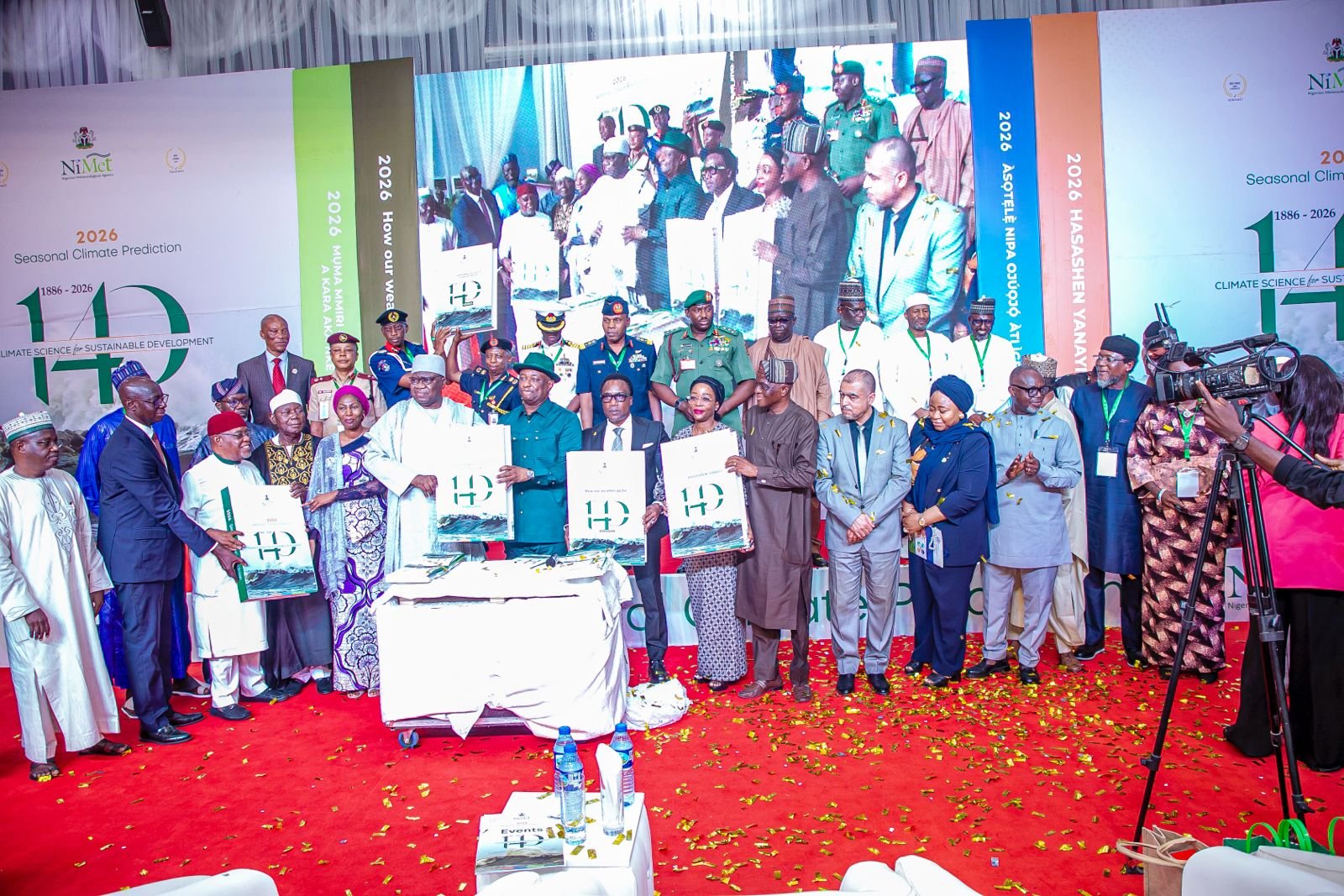
Nigeria is heading into a year of sharper climate contrasts, longer dry spells and rising temperatures, as the Nigerian Meteorological Agency (NiMet) has warned of a complex and high-risk weather outlook for 2026 that could reshape agriculture, infrastructure planning and disaster preparedness nationwide.
The warning was issued on Tuesday in Abuja during the official unveiling of NiMet’s 2026 Seasonal Climate Prediction and the 2025 State of the Climate in Nigeria, an event that drew senior government officials, policymakers, scientists, development partners and private sector leaders to the Nigerian Air Force Conference Centre.
Presenting the forecast, NiMet projected a mix of early and late rainfall onset, altered cessation dates, extended August Breaks, above-average temperatures and heightened climate risks across key sectors of the economy, underscoring the urgency for climate-smart national planning.

Delivering the keynote address, Minister of Aviation and Aerospace Development, Festus Keyamo, described the Seasonal Climate Prediction as a strategic national asset that has moved beyond routine weather forecasting to become a critical tool for governance, investment decisions and economic resilience.
Keyamo said NiMet’s early warning systems have played a growing role in improving agricultural outcomes and strengthening disaster preparedness, noting that climate variability and climate change are now central governance challenges affecting aviation safety, food security, national security, infrastructure development and public health.
He warned that extreme weather events including heatwaves, droughts, severe thunderstorms, windstorms and sandstorms are occurring with increasing frequency, making the integration of climate data and meteorological science into policy planning unavoidable.
According to the minister, the Tinubu administration has placed priority on economic stability, food security, climate adaptation, infrastructure resilience and the protection of lives and livelioods, stressing that timely and accurate weather information is now a strategic enabler rather than an optional service.
Keyamo said the 2026 Seasonal Climate Prediction aligns with the Renewed Hope Agenda by translating complex climate signals into practical guidance for policymakers, investors and sector leaders, while reaffirming his ministry’s commitment to strengthening NiMet’s capacity.
Tracing Nigeria’s climate monitoring history to the establishment of the country’s first weather observation station in 1886, the minister commended NiMet’s evolution into a modern, multi-sectoral agency whose services now support agriculture, water resources, health, transportation, energy planning, disaster risk reduction and national security.
On the science behind the forecast, he disclosed that the 2026 outlook was developed using global best practices, combining long-term climate data, real-time observations and major global climate drivers such as the El Niño–Southern Oscillation and the Indian Ocean Dipole.
According to the projection, the rainy season is expected to begin early in Bayelsa, Rivers, Akwa Ibom, Cross River, Benue, Kogi, Nasarawa and Oyo States, while Borno State is likely to experience a delayed onset. Rainfall is projected to end earlier than normal in parts of Ogun, Osun, Ondo, Imo, Rivers, Akwa Ibom, Kogi and Niger States, while a late cessation is expected in Lagos, Ogun, Anambra, Enugu, Cross River, Benue, Nasarawa and Kaduna.
Read also:
- NiMet rejects claims of N5tn loss, by farmers defends weather forecast accuracy
- NiMet forecasts sunshine, cloudiness for 3 days starting Tuesday
- NiMet ranks top 10 nationwide with 82.65% score in ICPC’s 2025 Ethics and Integrity Assessment
NiMet forecast near-normal annual rainfall across most of the country, with above-normal rainfall expected in Borno, Sokoto, Kebbi, Kaduna, Enugu, Cross River, Abia, Ebonyi, Akwa Ibom and the Federal Capital Territory. Below-normal rainfall is projected for parts of Katsina, Zamfara, Kwara, Oyo and Ogun States.
The outlook also warns of increased dry spell risks, including severe dry periods exceeding 15 days between March and May in parts of Oyo and Ogun States. Extended dry spells of up to 21 days are expected during the June to August period in several northern and central states.
Particularly concerning is the forecast of a prolonged and more intense August Break in Lagos, Ogun, Ekiti and parts of Oyo, a development that could significantly affect crop yields, water availability and urban livelihoods.
NiMet said the 2026 climate outlook reinforces the need for proactive planning by governments, farmers, businesses and emergency agencies, as climate patterns become more unpredictable and their economic consequences more severe.