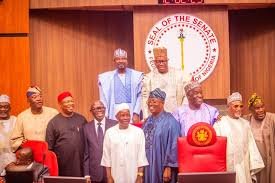
The Senate has named a 12-member committee to work with the House of Representatives on the controversial Electoral Act Amendment Bill, following nationwide outrage over contentious provisions in the proposed law.
Senate President Godswill Akpabio, announced the composition of the committee on Tuesday during an emergency plenary session convened to address growing tension around the amendment process.

The move comes amid sustained protests and sharp criticism from civil society groups, opposition figures and sections of the public over clauses widely perceived as attempts to weaken electoral transparency, particularly provisions touching on electronic transmission of election results.
Among the senators named to the harmonisation committee are Senator Orji Uzor Kalu and Senator Tahir Monguno, alongside 10 other lawmakers whose names were read on the floor of the chamber.
Read also:
- Senate to hold emergency sitting today over Electoral Act controversy
- The Senate and the Shadows on Democracy: The Battle Over Real-Time E-Transmission of Results
- Chaos in Senate as lawmakers clash over ‘Real-Time’ electronic transmission in Electoral Act Amendment
Akpabio said the committee would interface with its counterpart in the House of Representatives to reconcile differences in both chambers’ versions of the Electoral Act Amendment Bill before it is transmitted to President Bola Tinubu for assent.
The development follows weeks of legislative controversy, with the Senate recently revisiting disputed clauses of the Electoral Act, triggering heated debates and public demonstrations.
Critics argue that any dilution of electronic result transmission would undermine credible elections and potentially fuel post-election violence.
Prominent political figures, including Labour Party presidential candidate in the 2023 election, Peter Obi, have warned that “network excuses” are no longer acceptable in an era of widespread digital banking and communication.
Former Rivers State Governor, Rotimi Amaechi has also argued that real-time transmission of results could reduce election-day violence.