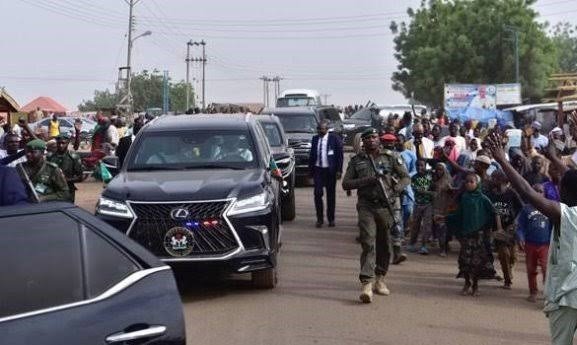
A fresh wave of public anger has swept across Nigeria following the emergence of a viral video showing the long convoy of the Minister of the Federal Capital Territory, Nyesom Wike, during a recent visit to Port Harcourt, Rivers State. The footage, which circulated widely on social media, has reignited a national debate over the rising cost of governance at a time when millions of Nigerians are struggling under severe economic pressure.
The incident occurred on February 7, 2026, when Wike arrived in Port Harcourt to commission the Renewed Hope Ambassadors Secretariat, a political structure aligned with President Bola Tinubu’s administration and widely seen as part of early mobilisation efforts ahead of the 2027 general elections. What was intended to be a show of political strength quickly turned controversial after observers counted more than two dozen vehicles, accompanied by motorcycle escorts, stretching across major roads in the city.

Images of the convoy triggered sharp reactions online, with many Nigerians questioning the optics of such an elaborate display in the midst of widespread hardship. Critics described the scene as a symbol of elite excess, contrasting it with the daily reality of citizens facing soaring transport fares, rising food prices, and shrinking incomes. Several commentators pointed out that leaders in far wealthier countries often travel with far smaller security details, making the scale of the convoy even more jarring.
The outrage has also revived concerns over the allocation of security resources. Nigeria continues to battle insurgency, banditry, and violent crime across several regions, yet large numbers of security personnel are routinely deployed to protect political office holders. Analysts argue that the prioritisation of VIP protection over community safety reflects a deeper imbalance in governance and national planning.
Read also:
- Midnight Truce at Aso Rock: Tinubu brokers peace as Fubara, Wike hold secret talks in Abuja
- “No More Glitches”: Peter Obi leads #OccupyNASS protest as Nigerians ask, where is Atiku?
- Free or Paid? NERC breaks silence on electricity meter charges as Nigerians cry foul
The timing of the controversy has further amplified public frustration. Since taking office in 2023, President Tinubu’s administration has implemented far-reaching economic reforms, including the removal of fuel subsidy, exchange rate liberalisation, and tax harmonisation. While the government says these policies are necessary to stabilise the economy, they have imposed heavy burdens on households and businesses.
Inflation has eased slightly in recent months, but the cost of living remains high, with food inflation and transportation costs continuing to strain family budgets. Poverty levels have climbed, pushing more Nigerians below the poverty line, while unemployment and underemployment persist. Small and medium-sized businesses, widely regarded as the backbone of the economy, have been forced to scale down or shut their doors due to rising operating costs.
Against this backdrop, Wike’s convoy has become a rallying point for calls demanding restraint, accountability, and fiscal discipline among public officials. Critics argue that maintaining and fuelling long convoys, alongside other forms of official extravagance, drains scarce public resources that could be redirected toward healthcare, education, infrastructure, and social welfare.
Public finance experts note that Nigeria’s fiscal position remains fragile, with low revenue generation, rising debt servicing obligations, and persistent gaps in capital project execution. They warn that without visible efforts to cut waste and reduce the cost of governance, public confidence in ongoing economic reforms will continue to erode.
For many Nigerians, the controversy goes beyond one convoy or one official. It reflects a broader perception of disconnect between political leaders and the people they govern. As the country pursues ambitious economic targets and seeks to rebuild trust, citizens are increasingly demanding leadership that matches sacrifice with sacrifice.
Wike’s convoy, now etched into public discourse, has become more than a viral moment. It stands as a stark reminder that in an era of shared pain, displays of excess carry political and moral consequences. Whether this renewed public pressure will translate into meaningful reforms in governance spending remains to be seen, but the message from the streets and online platforms is unmistakable: Nigerians want prudence, not pageantry.