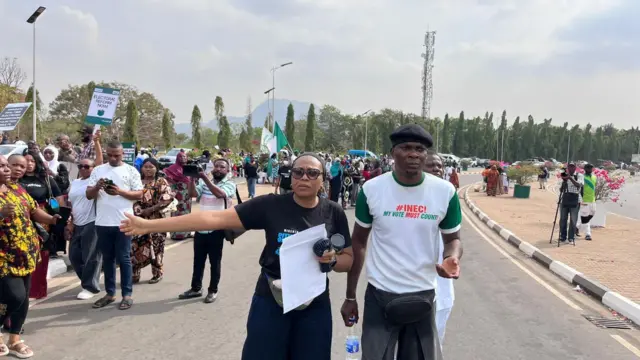
Protesters on Monday converged on the entrance of the National Assembly Complex in Abuja, demanding clarity and transparency over the controversial amendment of the Electoral Act, particularly the provision on electronic transmission of election results.
The demonstrators, made up of civil society activists and concerned citizens, said they were mobilised by reports that the Senate had rejected a clause mandating real-time electronic transmission of election results.

They accused lawmakers of attempting to weaken electoral transparency ahead of future polls.
Chanting slogans and wielding placards, the protesters insisted that the amended law must explicitly include the phrase “real-time electronic transmission” to prevent what they described as deliberate ambiguity that could be exploited during elections.
Although the Senate has since issued statements denying any backtracking and insisting that its position does not undermine electronic transmission, the protesters dismissed the explanations, describing them as evasive and inadequate.
Read also:
- Ughelli North APC adopts Lucky Ofomukoro as consensus Chairman ahead of party congress, Omo-Agege, others remain mute
- NLC supports electronic-transmission of election results in Electoral Act
- Press freedom advocate condemns intimidation, harassment of journalists
According to the demonstrators, previous elections have shown that vague legislative language often creates loopholes that are later weaponised to compromise the credibility of the electoral process.
A heavy security presence was deployed around the National Assembly, with the police, army, and Nigeria Security and Civil Defence Corps (NSCDC) operatives barricading access points to prevent the protest from escalating.
The protest comes amid heightened public scrutiny of the ongoing Electoral Act amendment process, with critics warning that any dilution of electronic transmission provisions could erode public confidence in Nigeria’s electoral system.
As of the time of filing this report, lawmakers had not formally addressed the protesters, while security agencies continued to monitor the situation to forestall a breakdown of law and order.