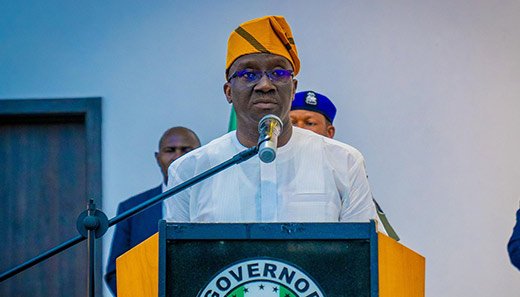
Edo State is witnessing a quiet but powerful transformation — one driven not by slogans, but by steel, concrete and visible progress on the ground. At the heart of this transformation is the Ikpoba Hill flyover at Ramat Park, a project Governor Monday Okpebholo recently inspected and described with clear satisfaction, not as a ceremonial achievement, but as a living proof of his administration’s commitment to infrastructure renewal.
On his way back from Udomi-Uwessan in Irrua, where he had just concluded a three-day strategic leadership retreat for political appointees, the governor made a stopover at the construction site. Accompanied by top government officials, he climbed the structure, surveyed the work, and spoke directly to contractors — not from an office, but from the top of the bridge itself.

“This is our normal routine check,” the governor said. “It’s just to see what they are doing, and for them to know that we are serious, and for them to also buckle up so that this job is completed with all the speed it requires.”
From the elevated vantage point, it was clear that the project had moved beyond foundation work. Backfilling was already underway, structural casting was nearing completion, and the bridge was visibly taking its final shape. Governor Okpebholo did not hide his approval.
“They are doing a good job. You can see they’ve started backfilling, and by the time they cast this part, the job is already at the point of completion,” he said.
The governor was conducted round the site by Mr. Lee, Project Manager of the China Civil Engineering Construction Corporation (CCECC), the firm handling the construction. What emerged from the inspection was not just a technical update, but a broader narrative of urgency, discipline and performance — hallmarks that are fast becoming synonymous with the Governor Okpebholo administration.
Yet, perhaps the most telling reaction did not come from officials, but from the people.
Read also:
- 2027: Votes will count with President Donald Trump watching, says CRPP National Chairman
- FA Cup: Ingas FC suffers penalty loss in Enugu
As news of the governor’s visit spread, traders and residents around Ramat Park reportedly shut down their shops in spontaneous celebration. Cheers erupted, prayers were offered, and faces lit up — not because a politician had passed through, but because a long-standing problem was finally being solved.
One trader, visibly emotional, captured the mood of the community: “I am so excited with what I am seeing today. This flyover bridge is giving us all joy. When we saw the governor on top of the bridge checking out the work done, we just prayed for him that God will bless his works. He is a good man.”
That statement, simple and unscripted, speaks volumes. For years, Ikpoba Hill and Ramat Park have been synonymous with traffic gridlock, accidents, lost man-hours and daily frustration. What should have been a busy commercial corridor became a bottleneck that drained productivity and tested patience. Now, that narrative is changing.
But the flyover is only one part of a larger story.
Alongside the bridge construction is a major erosion control project, designed to tackle the environmental challenges that have plagued parts of Benin City for decades. Flooding, gully erosion and collapsing road edges have not only damaged infrastructure but displaced families and disrupted livelihoods. By addressing both traffic congestion and environmental degradation simultaneously, the Governor Okpebholo administration is demonstrating a holistic approach to urban renewal.
This dual intervention — flyover and erosion control — reflects a deeper philosophy: infrastructure is not just about movement; it is about stability, safety and dignity.
Governor Okpebholo’s leadership style has been marked by a hands-on approach. He does not wait for glossy reports or staged briefings. Instead, he visits project sites, questions contractors, listens to residents and insists on speed, quality and accountability. This pattern of routine inspection sends a powerful message — that projects will not be abandoned, and excuses will not be entertained.
More importantly, it restores public confidence in government delivery. In a political environment where citizens have grown wary of unfulfilled promises and abandoned projects, visible progress on a structure as symbolic as a flyover becomes a statement of credibility.
The Ikpoba Hill flyover also represents something bigger than traffic decongestion — it is a symbol of economic intent. Better roads attract investors, reduce transport costs, improve logistics, and stimulate commerce. For traders, transporters, artisans and commuters, this bridge is not just a structure; it is a pathway to opportunity.
Already, property owners and business operators around the axis are expressing renewed optimism. Reduced congestion means faster turnover, increased customer access and a more attractive business environment. In urban economics, infrastructure is the silent driver of prosperity — and Edo State is positioning itself to benefit from that reality.
Politically, the flyover projects have become defining markers of the Governor Okpebholo administration’s first phase. Supporters see them as evidence that governance is shifting from rhetoric to results. Critics, while raising broader concerns about governance priorities, cannot ignore the physical transformation unfolding at major junctions across Benin City.
As construction nears completion, attention is turning to other intersections and corridors slated for similar interventions. The administration’s broader infrastructure blueprint includes multiple flyovers, road expansions and drainage systems — all aimed at modernising Edo’s transport network and preparing the state for future growth.
What makes this moment particularly significant is the timing. At a period when many Nigerians are grappling with economic pressure, infrastructure offers not just convenience, but relief — relief from wasted hours, from daily stress, and from the sense that government is absent from everyday struggles.
Standing atop the flyover, Governor Okpebholo did more than inspect a project. He embodied a message: that leadership is present, progress is possible, and transformation is underway.
In the end, the Ikpoba Hill flyover is not just a bridge across a road. It is a bridge between old frustration and new hope. It is concrete proof that when governance is driven by purpose, discipline and empathy, the landscape — both physical and social — can truly change.
And for the people of Edo State, that change is no longer a promise. It is rising, casting shadows, redirecting traffic — and rewriting the story of a city on the move.