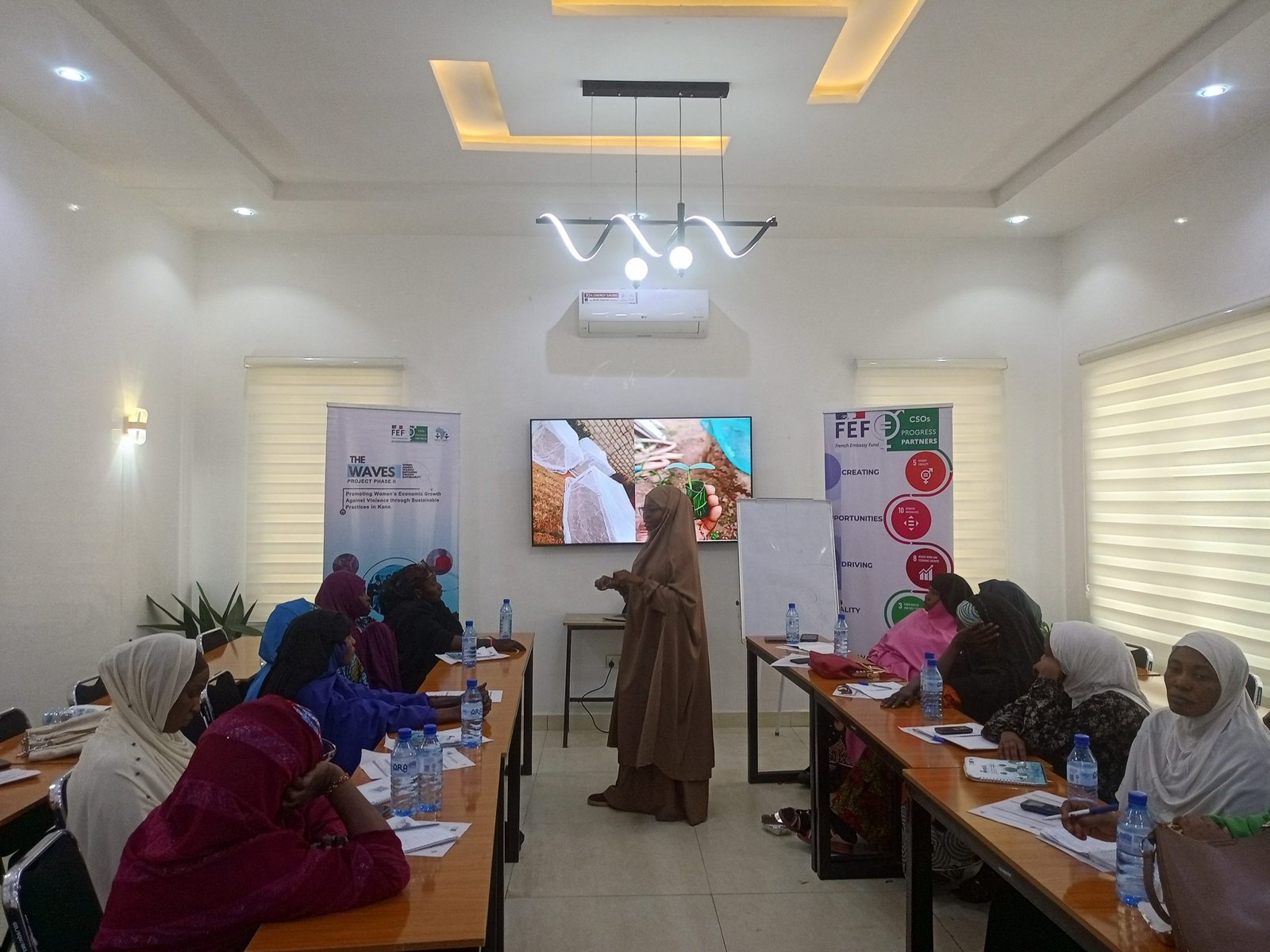
A non-governmental organisation, Bridge Connect Africa Initiative (BCAI), has trained 16 women from Kano State on Climate-Smart Agriculture as part of efforts to strengthen women’s economic empowerment and improve household food security amid the growing impact of climate change.
The two-day Training of Trainers programme was held under Phase II of the Women Against Violence Empowered through Sustainability project and received support from the French Embassy Fund for Civil Society Organisations. The initiative focused on equipping women with practical and adaptable agricultural skills that can be applied at the community level.

Speaking during the training, the WAVES Project Lead, Mr Nathan Bako, said the programme was designed to deepen participants’ understanding of climate-smart agricultural practices while building their capacity to promote and scale them within their communities. He explained that the women had previously received hands-on training in bed and sack or container farming for crops such as cucumber and okra.
Bako noted that the latest phase of the programme went further by providing facilitation skills, simplified technical knowledge, and leadership confidence to enable the participants to serve as community champions for climate-smart agriculture. According to him, the women are expected to conduct step-down trainings in their localities, sharing low-cost and adaptable farming techniques that can enhance food production and climate resilience.
Read Also:
- 20,000 Kano youths return from irregular migration in 5 years — NGO
- NGO hails Wike over bold steps to tackle Abuja refuse crisis
- Governor Yusuf approves Hajj, House, welfare support for father of murdered Kano family, orders speedy trial
Also speaking, the Programmes Associate of BCAI and Project Programme Manager, Hajiya Ruqayya Abdulhadi, said the 16 women were selected from eight clusters across Kano State. She explained that they emerged from an initial pool of 50 women who benefited from the project’s foundational training.
Abdulhadi disclosed that each participant is expected to train at least 20 other women, bringing the projected reach of the programme to about 200 women across the state. She expressed confidence that the initiative would not only promote sustainable agricultural practices but also contribute to reducing gender-based violence by improving women’s economic stability.
A resource person at the training, Hajiya Fatima Muftau, facilitated sessions on soil and nutrient management, water and crop management, as well as monitoring and evaluation techniques relevant to climate-smart farming.
Speaking on behalf of the participants, Hajiya Zainab Magaji-Suleiman from Tarauni Local Government Area described the training as timely and impactful. She pledged to replicate the skills and knowledge gained in her community to improve livelihoods and strengthen household food security.