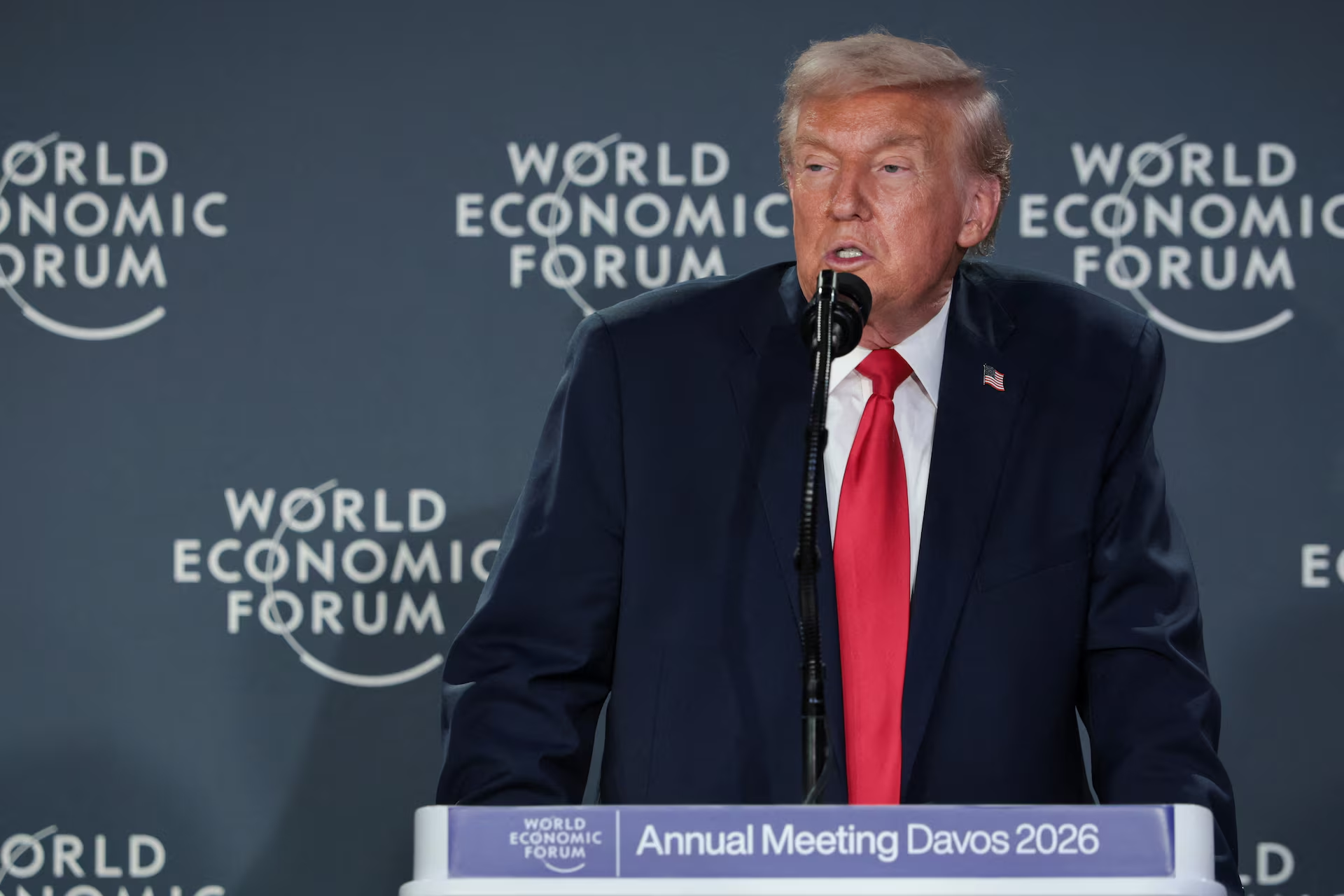
United States President Donald Trump on Wednesday appeared to soften his hardline stance on Greenland, stepping back from earlier threats to impose tariffs on European countries and ruling out the use of military force to acquire the Danish territory.
Speaking at the World Economic Forum in Davos, Switzerland, Trump said negotiations were moving toward a deal that would protect United States security interests in the Arctic while blocking the growing influence of Russia and China in the region.

“It’s a deal that everybody’s very happy with,” Trump told reporters. “It’s a long-term deal. It puts everybody in a really good position, especially as it pertains to security and to minerals.”
The shift in tone followed a meeting between Trump and NATO Secretary General Mark Rutte at the Alpine resort. In recent weeks, Trump had threatened escalating tariffs on eight European nations if they failed to cooperate over Greenland, a self-governing Danish territory with a population of about 57,000.
Rutte later played down speculation about Greenland’s ownership, saying the issue was no longer part of the discussions.
“That issue did not come up anymore in my conversations tonight with the president,” Rutte said in an interview with Fox News. “He is very much focused on what we need to do to make sure that that huge Arctic region, where change is taking place and where the Chinese and the Russians are increasingly active, is protected.”
A NATO spokesperson confirmed that talks involving Denmark, Greenland and the United States would continue, with the aim of ensuring Russia and China never gain a foothold in Greenland. No timeline or location was announced for the negotiations.
Trump said he had assigned Vice President JD Vance, Secretary of State Marco Rubio and special envoy Steve Witkoff to lead further discussions.
Read Also:
- Trump says he won’t use force to acquire Greenland
- Netanyahu agrees to join Trump’s Board of Peace
- Trump describes UK handing over Chagos Islands sovereignty as ‘great stupidity’
Earlier in his Davos address, Trump firmly rejected the idea of using force to acquire Greenland.
“People thought I would use force, but I don’t have to use force,” he said. “I don’t want to use force. I won’t use force.”
The softer approach calmed nervous financial markets. Wall Street rallied sharply, with the S&P 500 posting its biggest one-day percentage gain in two months, rising 1.16 percent. Trump’s aggressive remarks on Greenland a day earlier had triggered the steepest market sell-off in three months.
Denmark also welcomed the change in tone. Foreign Minister Lars Lokke Rasmussen said the sensitive issue should be handled through quiet diplomacy rather than public exchanges.
“What is crucial for us is that we end this with respect for the integrity and sovereignty of the kingdom and the right of the Greenlandic people to self-determination,” Rasmussen told Danish public broadcaster DR.
Greenland’s government declined to comment
Trump’s Greenland remarks dominated the Davos agenda, overshadowing his criticism of European countries over energy policy, immigration and defence spending. He described Denmark as “ungrateful” and referred to Greenland as a “small ask” involving a “piece of ice,” while insisting only the United States could adequately secure the territory. During his speech, he mistakenly referred to Greenland as Iceland several times.
“You can say yes, and we will be very appreciative, or you can say no, and we will remember,” Trump warned.
Russian President Vladimir Putin, quoted by Russian media, dismissed the issue, saying developments in Greenland were of no concern to Moscow.
Trump’s interest in Greenland is widely seen as part of a broader push to expand United States strategic influence in the Arctic, citing missile defence needs and access to critical minerals. It would represent the most significant territorial expansion since Alaska and Hawaii became states in 1959.
Trump is scheduled to meet Ukrainian President Volodymyr Zelenskyy on Thursday as part of his Davos visit.