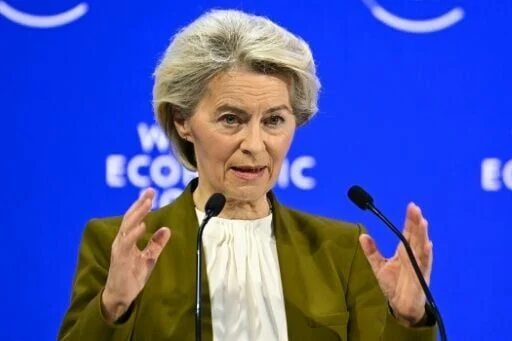
Europe is “fully prepared to act if necessary” over Trump’s Greenland tariffs threat, European Commission, President Ursula von der Leyen says
On Tuesday, French President Macron said the EU could consider a series of retaliatory options, including a “trade bazooka.”

The US president is en route to meet world leaders at the summit, but is running late after Air Force One was forced to turn around due to a “minor electrical issue.”
Trump is threatening to add a 10% tariff to “any and all goods” imported from eight European countries from February 1, if they oppose his proposed takeover of Greenland.
During a news conference at the White House late on Tuesday, Trump was asked how far he was willing to go to acquire Greenland, and he replied: “You’ll find out.”
But Greenland’s industry minister, Naaja Nathanielsen, tells the BBC Greenlanders are “bewildered” by Trump’s demands, adding: “We do not want to be Americans.”
The “Anti-Coercion Instrument” (ACI), which President Macron has spoken of, was approved by Brussels in 2023 in order to deter attempts by outside powers to force policy changes on the EU or member states.
At the time, the main threat was seen as coming from China, which had recently “punished” Lithuania for its links with Taiwan by putting restrictions on bilateral trade.
Today, there would appear to be a clear-cut case of another outside power, the United States, using commercial muscle to change European policy on Greenland.
Read Also:
- Protests mounts in Greenland, Denmark against Trump’s plans
- China announces record $1tn trade surplus despite Trump tariffs
- US approves sale of Nvidia’s advanced AI chips to China
In these circumstances, the “anti-coercion instrument” is an added weapon in the EU trade arsenal.
If there is agreement that coercion has been attempted by an outside power, and if negotiations to resolve the conflict fail, then the EU has enhanced powers to retaliate “within international law”.
According to the EU, “the ACI permits import and export restrictions to be placed on goods and services, but also on intellectual property rights and foreign direct investment.
“Additionally, the ACI enables the imposition of various restrictions on access to the EU market, notably to public procurement, as well as the placement on the market of products under chemical and sanitary rules.”
The ACI has never been used. Last year, during the negotiations over tariffs between the US and the EU, there was talk of the EU invoking it, but it never happened.