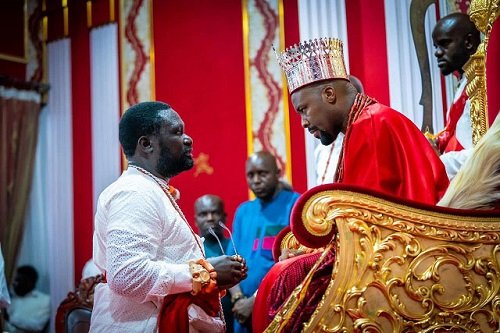
Tension in the oil-producing Niger Delta rose sharply on Monday as prominent Itsekiri leader and businessman, Chief Ayirimi Emami, popularly known as Atabrata, declared that he would “fight with my last blood” amid the worsening crisis rocking the Itsekiri nation and the Warri Kingdom.
The statement, delivered in Warri after another adjournment of a long-running court case over his suspension as Ologbotsere of Warri Kingdom, reflects the depth of anger and frustration surrounding a dispute that has dragged on for nearly four years. At the heart of the conflict are issues of traditional authority, succession, chieftaincy powers, and the control of influence within one of Nigeria’s most historically sensitive monarchies.
Chief Emami, a former Ologbotsere and one of the most influential figures in Itsekiri land, has remained a central character since the succession crisis that followed the death of Ogiame Ikenwoli in 2020. That episode exposed deep divisions over the process that led to the emergence of the current Olu of Warri, Ogiame Atuwatse III, as well as Emami’s suspension and subsequent dethronement, actions he has consistently challenged as illegal.

On Monday, the Delta State High Court, sitting in Warri, adjourned the Ologbotsere suspension case to March 16, 2026, after a scheduled pre-trial conference could not proceed. The matter is being heard by Justice Veronica Agboje at High Court 04, Warri.
Counsel to the claimant, Chief Emmanuel Uti, told journalists that the adjournment was caused by the second defendant’s failure to file court processes on time. According to him, the late filing disrupted the pretrial conference and necessitated the court granting additional time for reviewing the documents.
Uti insisted that the suspension of Chief Emami was carried out without legal backing, arguing that no ruling house, committee, or group of co-chiefs has the authority to suspend a chief in Warri Kingdom. He maintained that there was no binding code of conduct during the reign of the late Olu, Ogiame Ikenwoli, and that any action taken against the claimant lacked legal foundation.
He further disclosed that the claimant intends to rely on video evidence allegedly showing one of the defendants, Chief Mene Brown, stating that princes have no authority over chiefs, a claim the legal team says may strengthen Emami’s case.
Counsel to the seventh to tenth defendants, Ame Oriakhi, opposed the application, arguing that the suspension had already taken effect and that subsequent developments had overtaken the claimant’s demands. He stated that a substantive Ologbotsere had since been appointed by the Olu of Warri and is currently performing the functions of the office.
Oriakhi also noted that the suspension occurred before the ascension of the current Olu and claimed that efforts were later made to reconcile the parties. According to him, Chief Emami was offered another chieftaincy title, which he rejected, making the present court action unnecessary in his view.
Reacting angrily to the adjournment, Chief Ayiri Emami accused the defendants of deliberately frustrating the case through repeated delays. He said the matter was straightforward and insisted that no family or group in Itsekiri land has the power to suspend a chief.
“This case has been lingering for almost four years. They think I will give up, but I will never give up,” Emami said, adding that he and the Ologbotsere family were fully prepared to proceed when the court reconvenes.
The spokesperson of the Ologbotsere descendants worldwide, Comrade Alex Eyengho, also condemned the repeated adjournments, describing the case as legally simple. He maintained that the suspension of the Ologbotsere undermined the traditional structure of the Warri Kingdom and distorted the succession process.
Read also:
- College of Education Warri organises workshop to boost staff productivity
- You’re a liar, Eucharia Anunobi replies Apostle Okpe over sexual relations claim
- Ubabiri officially assumed throne as Agadagba of Egbema Kingdom
Beyond the courtroom, Emami’s fiery declaration has reignited wider concerns about stability in Warri and surrounding communities. The phrase “fight with my last blood,” while not new in Itsekiri political expression, highlights the emotional weight of the dispute and the deep sense of grievance among his supporters, who see him as a defender of Itsekiri heritage and ancestral rights.
Observers warn that the renewed escalation could threaten the fragile peace in the Niger Delta, a region where past ethnic and chieftaincy disputes have disrupted oil production and security. With investigations into related communal tensions still ongoing, many fear that unresolved grievances could spiral into broader unrest if dialogue and restraint do not prevail.
As the case heads back to court in March, the Itsekiri nation stands at a crossroads. Chief Ayiri Emami’s words have drawn a clear line in the sand, signalling that the struggle over power, identity, and tradition in Warri Kingdom is far from over, with implications that reach well beyond the palace walls.