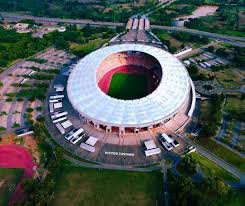
Nigerians may soon witness another massive public spending spree as the Moshood Abiola National Stadium in Abuja is slated to gulp N24,642,000,000 from the N203,602,968,852 budget earmarked for the National Sports Commission (NSC) in 2026.
The 60,491-capacity stadium, opened in 2003 under former President Olusegun Obasanjo to host the 8th African Games, has long been criticized for its deteriorating pitch and substandard facilities despite repeated renovations.
NSC Chairman, Shehu Dikko, had previously promised that work on the stadium would commence by the end of 2025 to revive Nigeria’s sports infrastructure.

But records show that a renovation executed between 2020 and 2022, which included the installation of Pure Dynasty Paspalum grass, two digital scoreboards, 24 sprinklers, nursery beds, and a two-year maintenance plan, failed to restore the pitch to international standards.
The stadium’s poor condition forced the Super Eagles to relocate their home matches to the Godswill Akpabio Stadium, Uyo.
The last game hosted in Abuja ended in a 1–0 loss to Guinea-Bissau on March 24, 2023, with former coach José Peseiro publicly blaming the pitch.
Despite these setbacks, the NSC, under President Bola Tinubu’s “Budget of Restoration,” has earmarked N18.775 billion for the first phase of stadium rehabilitation, N5.8 billion for a high-performance center, and N65 million for internet and IT infrastructure.
An additional N15.5 billion is set aside for a sports secretariat at the stadium.
Read also:
- 2023: Live Updates, results from National Stadium, Abuja
- Tottenham’s Davies to miss Wales’ World Cup play-off over ankle surgery
- Coco Gauff sheds tears after defeating Croatia’s Donna Vekic 7-6 (7-5) 6-2 at the US Open
Other allocations in the 2026 sports budget include N4.22 billion for the 2026 Commonwealth Games in Glasgow, N5.1 billion for preparations ahead of the 2028 Olympics in Los Angeles, and N1 billion for Nigeria’s participation in the 2026 Winter Olympics in Italy.
Football, both men’s and women’s national teams, will receive N14.2 billion for AFCON 2025 and upcoming international tournaments.
Critics argue that the decision to commit tens of billions to a stadium that repeatedly fails FIFA standards raises serious questions about accountability and oversight.
The public is left to wonder if the new injection of funds will finally deliver a world-class facility or become another case of wasted government spending.