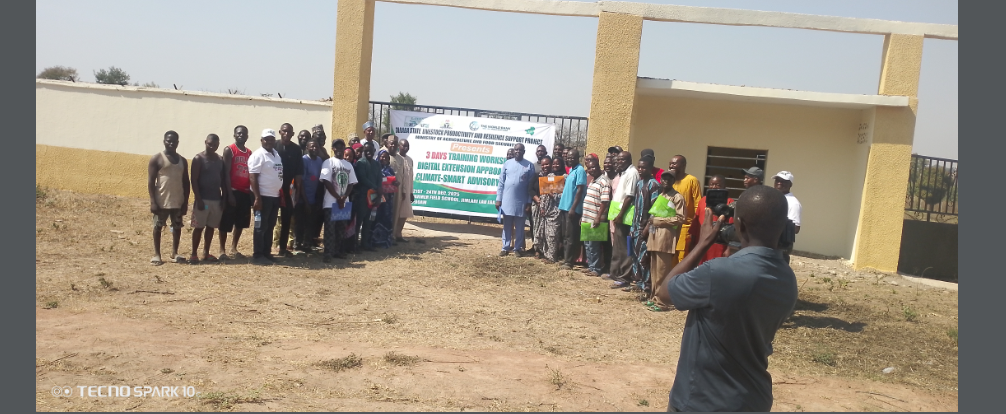
The Taraba State Livestock Productivity and Resilience Support Project (L-PRES), in collaboration with the Ministry of Agriculture and Food Security, has concluded a three-day training workshop on digital extension approaches and climate-smart advisory services for agricultural extension agents.
The training, aimed at strengthening agricultural productivity and resilience in the state, was held at the Farmers Field School, Jimlari, in Lau Local Government Area.

Declaring the workshop open, the Commissioner for Agriculture and Food Security, Prof. Nicholas Oliver Namessan, represented by the Director of Livestock Services, Mr. Dame Musa Buhari, said agriculture in Taraba State is facing increasing challenges due to climate change.
He noted that unpredictable rainfall patterns, rising temperatures and emerging pest threats have made traditional farming practices inadequate for ensuring food security, stressing the need for modern, technology-driven extension systems.
According to him, digital extension services will enable farmers to access real-time information such as weather forecasts, market prices and customised advisory services through mobile phones, internet platforms and data analytics, thereby overcoming challenges of distance and limited extension manpower.
The commissioner also highlighted the importance of climate-smart advisory services, which he said are designed to boost productivity, strengthen resilience to climate shocks and reduce greenhouse gas emissions.
He urged extension agents to transfer the knowledge acquired during the training to farmers at the grassroots, assuring them of the ministry’s continued support.
Read Also:
- Army arrest notorious bandit leader terrorising Taraba, Benue
- FC Belaz striker advocates reviving sports development in Taraba
- UNICEF urges contractors to deliver quality healthcare projects in Taraba
The State Project Coordinator of L-PRES, Mr. Hananiah G. Albert, described the training as critical to the success of the project.
He acknowledged the support of Governor Agbu Kefas and explained that L-PRES is a World Bank-funded project focused on livestock development, particularly cattle, sheep, goats and poultry, where the state has comparative advantages.
Represented by the L-PRES ICT Officer, Mr. Ezra Artimas, the coordinator said the training involved 60 extension agents and was organised under sub-component 1.2 of the project to strengthen extension service delivery through digital tools and climate-smart livestock advisory practices.
He added that participants were trained on digital extension platforms, climate-smart advisory services and best practices in animal husbandry to enhance farmer support and improve livelihoods across the state.
Mr. Albert commended the Ministry of Agriculture and Food Security, the national coordination office of L-PRES, trainers and participants for their commitment to advancing livestock development in Taraba State.