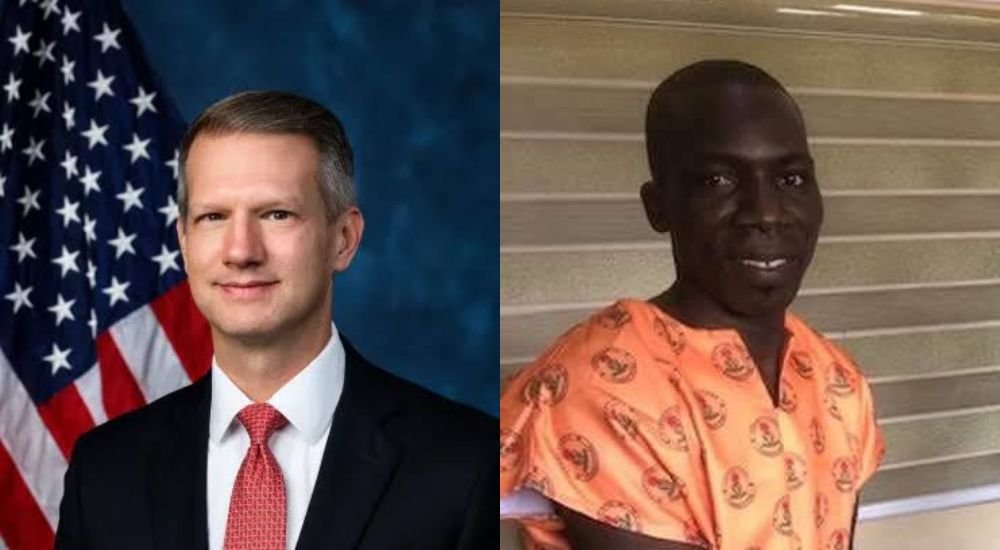
United States Lawmaker Riley Moore, has commended Adamawa State Governor Ahmadu Umaru Fintiri and the Nigerian government for the release of Sunday Jackson, a Christian farmer who had spent over ten years on death row.
Jackson was convicted for the killing of a Fulani herdsman during a violent incident that his supporters claim was an act of self-defense. He was eventually pardoned by Adamawa State Governor, Ahmadu Fintiri.
In response to this development, Moore stated that Jackson’s release indicates that the Nigerian government is starting to take the concerns raised by the United States seriously.

“Sunday Jackson is free. After more than a decade in prison facing a death sentence for defending himself, he has now been pardoned,” Moore said in a statement.
He mentioned that he had advocated for Jackson’s release through public campaigns and private discussions, including during a recent trip to Nigeria with a US congressional delegation.
Moore revealed that Jackson’s release was a significant condition for dialogue with Nigeria, especially after the country was recently classified as a country of particular concern by US President Donald Trump.
He noted that the US government had insisted on Jackson’s release, which prompted Governor Fintiri to grant pardons to Jackson and seven other inmates.
Moore expressed optimism that both his concerns and those of President Trump are now being taken seriously by Nigerian officials. He also urged both federal and state governments to ensure Jackson’s safety following his release.
Read also:
- Gov. Fintiri grants pardon to farmer sentenced to death in Adamawa
- Adamawa gov grants pardon to death row inmate, five others
- Kaduna govt confirmed 32 locals killed by terrorists
Additionally, Moore hinted that discussions are ongoing between the two nations to establish a joint security framework to tackle Nigeria’s security issues.
Jackson’s case dates back to 2015 when he was attacked on his farm in Adamawa State after confronting a herdsman who was grazing cattle on his property. He was stabbed during the altercation and later retaliated, resulting in the herdsman’s death from his injuries.
Jackson was arrested, tried, and convicted of manslaughter, receiving a death sentence by hanging, a ruling that was later upheld by Nigeria’s Supreme Court.
The case drew significant criticism from human rights organizations both within Nigeria and internationally.