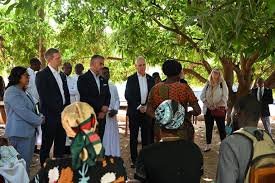
A wave of anger has swept through Idomaland after a visiting United States Congressional delegation failed to include any Idoma community in its fact-finding tour of Benue State, despite rising insecurity and repeated appeals for global attention. The delegation met displaced persons, religious leaders and traditional authorities in Tiv areas earlier in the week but bypassed Benue South, a move that has stirred outrage across Idoma platforms and intensified long-standing concerns about marginalisation.

The visit came shortly after the United States designated Nigeria a Country of Particular Concern over attacks on Christian communities. Yet, as of Thursday, neither the federal government nor the visiting American lawmakers had addressed the reason for excluding Idomaland from their itinerary.
Idoma youth activist Meddy Imanoel voiced his frustration in a widely circulated video, arguing that the oversight reflected both external neglect and internal silence. He said community leaders in the area had failed to speak boldly about the crisis, which has left countless families displaced without a single officially recognised IDP camp. He questioned why, despite the killings and destruction in Benue South, political leaders from the area have remained hesitant to raise their voices.
Another youth, John Ohene, accused the state government of setting the tone for the exclusion, alleging that the decision had more to do with local politics than the actions of the US delegation. He described glaring inequality in development and representation during his recent tour of the state.
A media organisation with Tiv interests, ZEVA TV, acknowledged the distress felt in Idomaland but appealed for calm, urging all groups to avoid deepening ethnic divides. It said faith leaders and traditional authorities who hosted the delegation spoke for victims across Benue, regardless of tribe.
Before arriving in Benue, the US lawmakers held talks with National Security Adviser Nuhu Ribadu in Abuja on counter-terrorism cooperation and religious-freedom concerns. In Benue, one of the delegates, Riley Moore, met survivors in multiple IDP camps and said their accounts would remain with him for life. He also met bishops and the Tor Tiv, assuring communities that their testimonies would not be ignored.
Read also:
- Foreign Nationals seized in Benue border community over alleged links to cross-border crime
- 80 families return to their ancestral homes from IDPs camps in Benue
- Inside the horror of Benue’s bloody Thursday
The controversy has emerged against a backdrop of worsening violence in Idoma communities including Ogbadibo, Agatu, Apa, Ohimini and Otukpo. The paramount ruler of the Idoma Nation, Elaigwu Odogbo, recently convened an emergency security meeting that ordered all armed herdsmen to leave the area. Local leaders say at least 75 people have been killed in Benue South this year alone, with vast stretches of farmland abandoned after sustained attacks.
Community groups in Apa insist nearly twenty villages have been overrun since early 2023. While MACBAN’s state leadership claims the armed groups are unknown to them, the devastation has continued unabated.
For many youths, the decision of the US delegation not to visit Idomaland underscores a deeper struggle for recognition. Residents say the outcry must now push state and federal authorities to ensure that victims across Benue receive equal attention and that security responses do not overlook any part of the state.