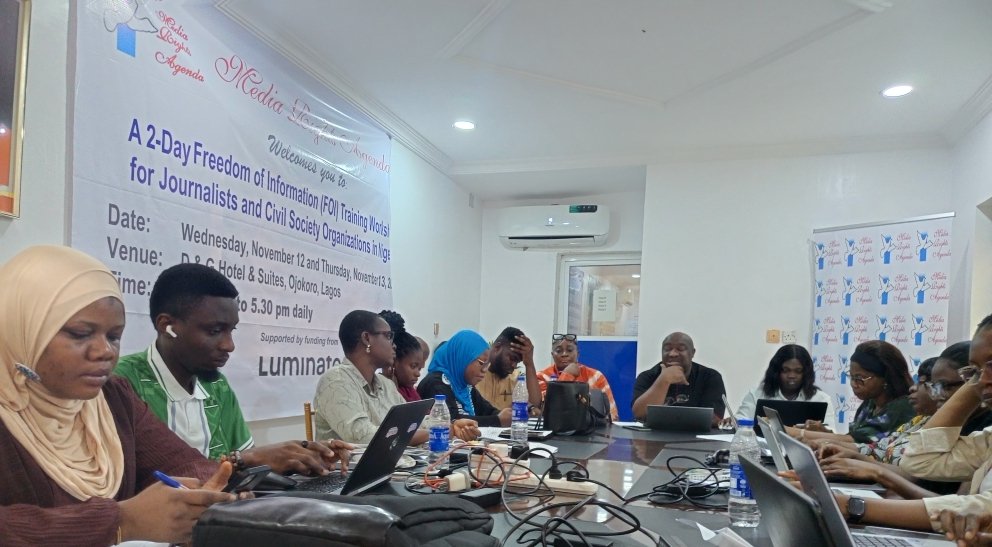
The Executive Director of Media Rights Agenda (MRA), Mr Edetaen Ojo, has called on journalists and civil society organisations (CSOs) to aggressively utilise the Freedom of Information (FOI) Act as a frontline tool in the fight against corruption and secrecy in public institutions.
Ojo made the call in Abuja at the opening of a two-day FOI Training Workshop for journalists and representatives of CSOs, held at Davina Hill Resort and Hotel.

Recalling the long struggle that birthed the law, Ojo said the FOI Act was signed into law on May 28, 2011, by former President Goodluck Jonathan after more than 12 years of sustained advocacy by civil society groups led by MRA. He noted that an earlier version of the Bill, passed by the National Assembly in 2007, failed to become law following the refusal of then President Olusegun Obasanjo to assent to it.
According to him, despite nearly 15 years since the enactment of the FOI Act, many public institutions continue to treat the law with indifference or outright hostility, undermining its purpose.
“The FOI Act is not a suggestion; it is a mandate. It does not confer privilege but guarantees a right that Nigerians must insist on,” Ojo said.
He stressed that the law fundamentally redefines the relationship between citizens and the state by making public officials mere custodians of records, while ownership of information rests with the Nigerian people.
Read also:
- Vandalism at Agip’s gas line cuts gas export, says Eni
- NAWOJ condemns torture of 14-year-old housemaid in Rivers, demands justice
- Issa-Onilu unveils vision to groom future leaders through National Values Charter
Ojo described the FOI Act as the most potent legal instrument for combating corruption, challenging official secrecy, and deepening accountability and public trust in governance, particularly at a time when journalists increasingly face threats and intimidation for asking legitimate questions.
He explained that the workshop was aimed at equipping participants with practical skills to draft effective FOI requests, navigate unlawful refusals and delays, and enforce compliance through judicial and non-judicial mechanisms.
The MRA executive director also announced the call for entries for the 2026 Goodluck Jonathan Freedom of Information Awards, which will recognise journalists who have distinguished themselves in promoting transparency and accountability through the effective use of the FOI Act.
Ojo commended Luminate for supporting the workshop and urged participants to collaborate beyond the training to ensure the FOI Act becomes a living instrument in Nigeria’s anti-corruption efforts.