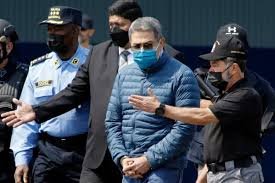
The former President of Honduras, Juan Orlando Hernández, has been released from a US prison, according to online records of federal inmates, after he received a pardon from US President Donald Trump for drug charges.
The records show Hernández was released from the high-security facility of USP Hazelton in West Virginia on Monday.
Hernández was found guilty in March 2024 of conspiring to import cocaine into the US and of possessing machine guns.
He was sentenced to 45 years in prison.
Read also:
Early Honduras election results show Trump’s ally ahead
Putin, Trump’s envoy set for key Ukraine talks in Moscow today
Costco sues Trump administration seeking a refund of tariffs
The US president said Hernández had been “treated very harshly and unfairly” in a social media post announcing the move last Friday.
Writing on her social media on Tuesday, Hernández’s wife, Ana García de Hernández, thanked Trump for the pardon, and said her husband was now a free man.
Hernández, a member of Honduras’s National Party who served as the country’s president from 2014 to 2022, was extradited to the US in April 2022 to stand trial for running a violent drug trafficking conspiracy and helping to smuggle hundreds of tonnes of cocaine to the US.
During his trial, prosecutors in New York said Hernández ran the Central American country like a “narco-state” and accepted millions of dollars in bribes from drug traffickers to shield them from the law.
He was also ordered to pay a fine of $8 million (£6m) as part of his sentence.
Trump explained his reasoning for the pardon while talking to reporters on Air Force One on Sunday.
He claimed the investigation into Hernández was a “Biden administration set up”, referring to his predecessor in the White House.
“They basically said he was a drug dealer because he was the president of the country,” Trump said.
Hernández’s release comes as Honduras is locked in a “technical tie” for the election of a new president.
As of Monday afternoon, just 515 votes were separating right-wing candidate Nasry Asfura from his nearest challenger, Salvador Nasralla, a former TV host standing for the country’s centrist party.
Trump criticised Nasralla on Friday, writing that he was “a borderline Communist” but characterised Asfura as “standing up for democracy” and praised him for campaigning against Venezuela’s President Nicolás Maduro, with whom Trump has engaged in a war of words in recent months.