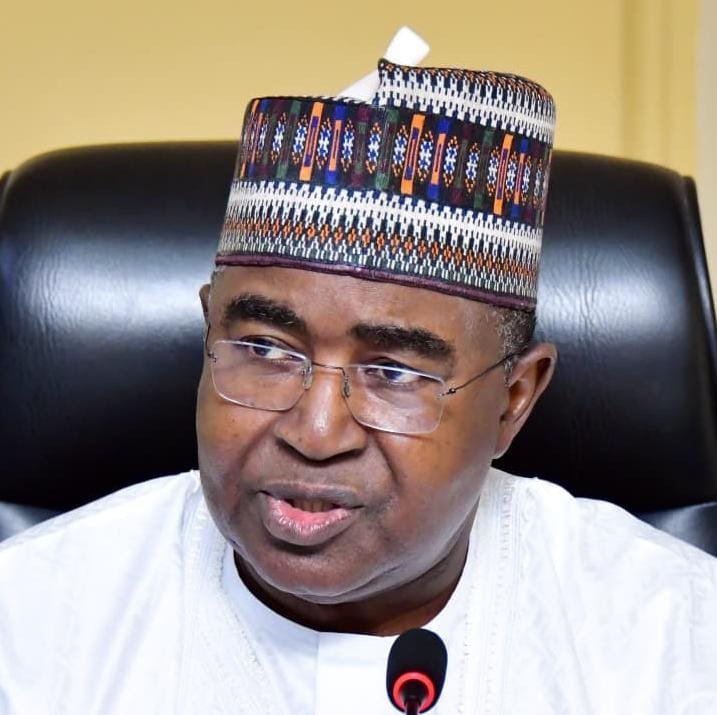
Chairman/Chief Executive of the National Drug Law Enforcement Agency (NDLEA), Brigadier General Mohamed Buba Marwa (retd.) on Saturday declared that Nigeria’s ethnic and cultural diversity remains a national asset that must be deliberately protected and strengthened by all citizens.
Marwa made the remarks in Abuja, while delivering the keynote address at the public presentation of Buni Boy, a book written by late legal scholar, Niyi Ayoola-Daniels.

He said the life and experiences captured in the book mirror an era when Nigerians lived with fewer prejudices and stronger bonds of unity, stressing that the country must return to those values if it hopes to overcome its current challenges.
“This story stirs my memories and reminds me of a time when life was plain in its blessings and people showed more kindness in their daily dealings,” Marwa said.
“Our diversity is not a burden but a gift and a trust we must safeguard.”
The NDLEA boss, who recounted his upbringing across Zaria, Enugu, Abeokuta and Lagos due to his father’s military postings, said those early experiences taught him to see people beyond ethnicity.
According to him, the Nigeria Military School (NMS), Zaria, where he spent his teenage years during the civil war, was a model of the country’s ideal — a place where ethnicity meant little and brotherhood meant more.
“We regarded ourselves as kin. Whether Hausa, Yoruba or Igbo, we simply saw Nigerians,” he said.
Read also:
- DCP Kyari Arrest: New Twist as Police Indict NDLEA Officers in Drug Trafficking
- NDLEA Nabs Power Indian businessman over smuggled 134,700 bottles of codeine
- NDLEA Intercepts Codeine Worth N2bn at Lagos Port
Marwa noted that his 30-year career in the army further deepened his belief in unity, saying the institution’s culture of intermarriage and camaraderie helped officers rise above ethnic sentiments.
In a rare revelation, Marwa recalled how, as military administrator of Lagos State, he resisted pressure from the military hierarchy to manipulate the 1999 governorship election against then candidate Bola Tinubu.
“Even though the Head of State, Gen. Abdulsalami Abubakar, did not interfere, the military hierarchy did,” he said.
“They instructed me to prevent Senator Bola Tinubu from emerging governor because of his pro-democracy activism in NADECO. But I chose to conduct a free and fair election that produced the most popular candidate.”
Marwa added that the love and support he enjoyed from Lagosians strengthened his resolve to allow the will of the people to stand.
“The rest today is history,” he said.
Marwa admitted that Nigeria’s diversity has been poorly managed over the years, leading to mistrust and tensions, but insisted that this must not be used as justification to call for the nation’s breakup.
“Our challenges should push us to repair the fault lines and pursue greater inclusion,” he said.
He praised the widow of the author, Mrs. Leticia Ayoola-Daniels, for preserving her husband’s legacy through the book and the Buni Yadi Foundation.
Marwa said the story resonates with him personally, not only because he once governed the old Borno State where Buni Yadi was located, but also because he knew the family of the Alkali whose principled judgment shaped the author’s life.
“The transformation of an eighteen-year-old boy in the 1960s and the wisdom of a judge who held firmly to justice reflect the heart of the Nigerian spirit,” he said.
The event was attended by legal practitioners, public officials, writers and family members of the late author.