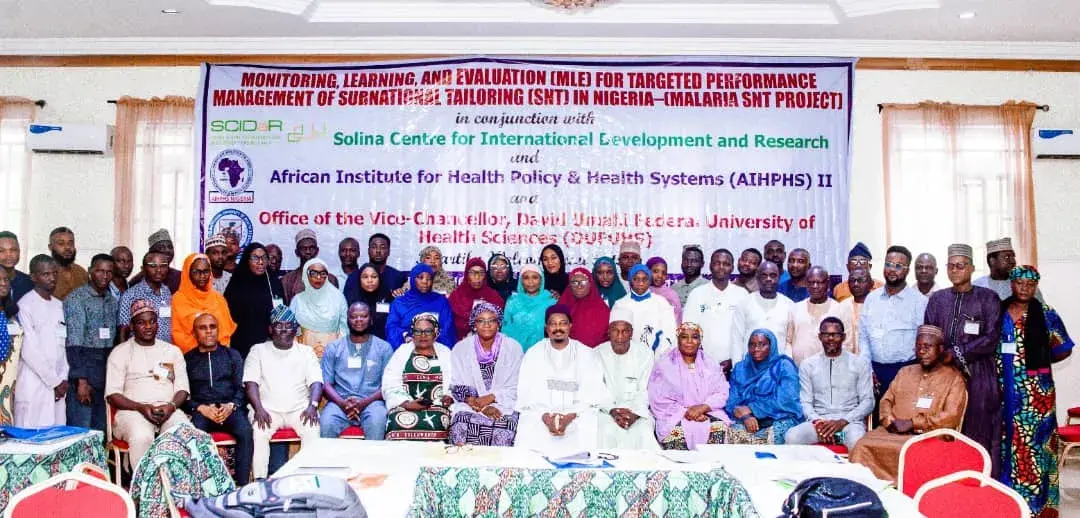
Experts and stakeholders in the health system have called for the lnstitutionalisation of Malaria strategic control plan to totally eliminate the scourge in Kaduna state.
The workshop was also to share the findings from the first co-creation workshop, deliberate on the first draft evidence for policy brief for malaria strategic plan subnational tailoring in Kaduna State, as well as deepen discussion on the institutionalization of the malaria strategic plan subnational tailoring in the state.
The Co-creation workshop/ engagement event was the second on “Promoting evidence-informed policymaking and implementation to facilitate Monitoring, Learning, and Evaluation (MLE) for Malaria Subnational Tailoring (MNT), held at Bafra lnternational Hotels, Kaduna state.

The event was organized by the African Institute for Health Policy and Health Systems, Nigeria and the Office of the Vice Chancellor, David Umahi Federal University of Health Sciences (DUFUHS), Uburu, Ebonyi state in collaboration with Solina Centre for International Development and Research, bill and Mellinda Gates Foundation.
In his opening remarks, the Vice Chancellor of David Umahi Federal University of Health Sciences, Uburu, Ebonyi state, Professor Jesse Uneke, who is also the Founder/ Director of the African Institute for Health Policy and Health Systems, Nigeria, commended the Kaduna State Government for the excellent commitment towards the elimination of malaria in Kaduna State.
He commended the stakeholders’ commitment to the project so far and to the malaria elimination program at large. He applauded the enthusiastic performance of the stakeholders during the last co-creation workshop in Kaduna.
Professor Uneke added that such level of enthusiasm is required in assessing the evidence brief for policy for malaria strategic plan sub-national tailoring, that has been drafted by his team using the findings from the last engagement with the stakeholders as well as available literatures.
He charged the stakeholders to be diligent in rating the performance of the National Malaria Strategic Plan (NMSP) 2021-2025 in the state and in suggesting ways to enhance the NMSP 2026-2030.
The keynote address for the event was taken by the permanent Secretary of Kaduna State Ministry of Health, Dr. Aishatu Abubakar Sadiq on behalf of the Honourable Commissioner for Health.
She commended the Vice Chancellor of DUFUHS, Professor Uneke and his team for organizing a second co-creation/ engagement event on malaria elimination in Kaduna State, adding that the engagement provides stakeholders with another opportunity for capacity development in the fight against malaria.
While appreciating the participants for their efforts in the malaria control in the state, she charged them to be proactive and implement the interventions more appropriately.
She encouraged the stakeholders to ensure that responses, interventions, and systems are tailored appropriately.
The permanent secretary emphasized on the need for stakeholders to always show willingness to learn new innovations and be adaptive to positive changes that will make a malaria-free Kaduna possible.
Read also:
- Understanding gene drives and their implications for African populations, ecosystems
- Over 5,000 benefit from federal lawmaker’s free medical outreach in Imo
- Edo govt assures improved access to care for aged citizens
Speaking on the lecture titled: “Promoting evidence-informed policymaking and implementation to facilitate Monitoring, Learning, and Evaluation (MLE) for Malaria Subnational Tailoring (MST) in Kaduna State part two”, Professor Jesse Uneke, the Health Policy and Health Systems expert, summarized the key milestones in the evolution of malaria policies and guidelines in Nigeria, from the colonial era of 1950s to the NMSP 2021-2025.
He argued that achieving further reductions in malaria burden in Nigeria, will require a shift from a one-size-fits-all approach to malaria programming towards a more targeted approach, which requires a renewed focus on the use of high-quality data for efficient planning and effective SNT program implementation.
The second plenary, which was taken by another Health Policy and Health Systems expert, Dr. Onyedikachi Chukwu, featured the results of the SWOT analysis of the malaria elimination program in Kaduna State, as well as the report of the stakeholders mapping done by the team in July 2025.
Some of the strengths highlighted were micro-planning strategy, Integrated Supportive Supervision Visit (ISSV), Social and Behavioral Change and Communication (SBCC), Routine Data Review (RDR), etc.
While commending the State for the efforts so far, he emphasized the need to address the weaknesses identified, which include poor data quality, stockout of Malaria commodities, non-correlation of MRDTs use with the ACTs dispensed, among others.
The event was well attended by about seventy-five (75) stakeholders, mainly policymakers and a few researchers from Kaduna State, selected from; Kaduna State Malaria Elimination Program, Kaduna State Primary Health Care Development Agency, Kaduna State Hospital Management Board, Solina Center, Malaria Consortium Kaduna State, Civil Society Organizations, Kaduna State Ministry of Environment, Kaduna State Ministry of Works and Infrastructure.