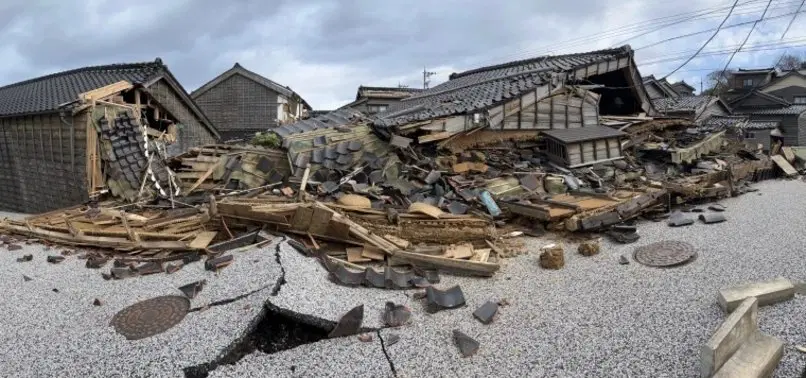
A 6.0 magnitude earthquake struck Japan’s remote Volcano Islands region in the early hours of Monday, March 2, 2026, according to the United States Geological Survey and other international monitoring agencies.
The tremor occurred at approximately 03:55 UTC, with its epicentre located in the North Pacific Ocean. Data released by the USGS placed the magnitude slightly higher at 6.1 on the moment magnitude scale. Initial assessments from the German Research Centre for Geosciences and other global seismic monitors estimated it at 6.0.

The quake was recorded at coordinates near 22.95°N and 144.30°E, at a shallow depth of about 10 kilometres, though some early reports suggested it may have occurred at a depth of 20 kilometres. Shallow quakes are often more strongly felt, but this event took place in a sparsely populated oceanic zone.
The Volcano Islands, known in Japan as Iwo Jima or Iōtō, form part of the Ogasawara archipelago. The chain lies roughly 1,000 to 1,400 kilometres south of mainland Japan and sits close to the Northern Mariana Islands. The region falls along the Pacific Ring of Fire, one of the world’s most seismically active belts, where major tectonic plates converge.
Read Also:
- Man who killed Japan’s ex-PM Shinzo Abe bags life sentence
- Scientists uncover potential “Cancer Assassin” in guts of Japanese Tree Frogs
- Japan to relaunch world’s largest nuclear power plant in Niigata
There were no immediate reports of damage, injuries, or casualties, largely because the epicentre was far from major population centres. The nearest significant landmasses were estimated to be about 280 to 300 kilometres away from the point of impact.
Japan’s Japan Meteorological Agency did not issue a tsunami warning following the earthquake, and there were no reports of abnormal sea waves affecting coastal communities. Authorities indicated that the tremor posed minimal threat to inhabited areas.
The Volcano Islands chain includes Iwo Jima, the site of a major World War II battle and currently home to a small Japanese Self-Defense Forces base. Even there, no disruption was immediately confirmed.
Japan remains one of the most earthquake-prone countries in the world, with strict building codes designed to withstand seismic shocks. Offshore quakes in volcanic regions are not uncommon, and residents are generally accustomed to periodic tremors.
Seismologists continue to monitor the area for possible aftershocks, although the remote location significantly reduces the risk to human populations. No signs of related volcanic activity have been reported.